


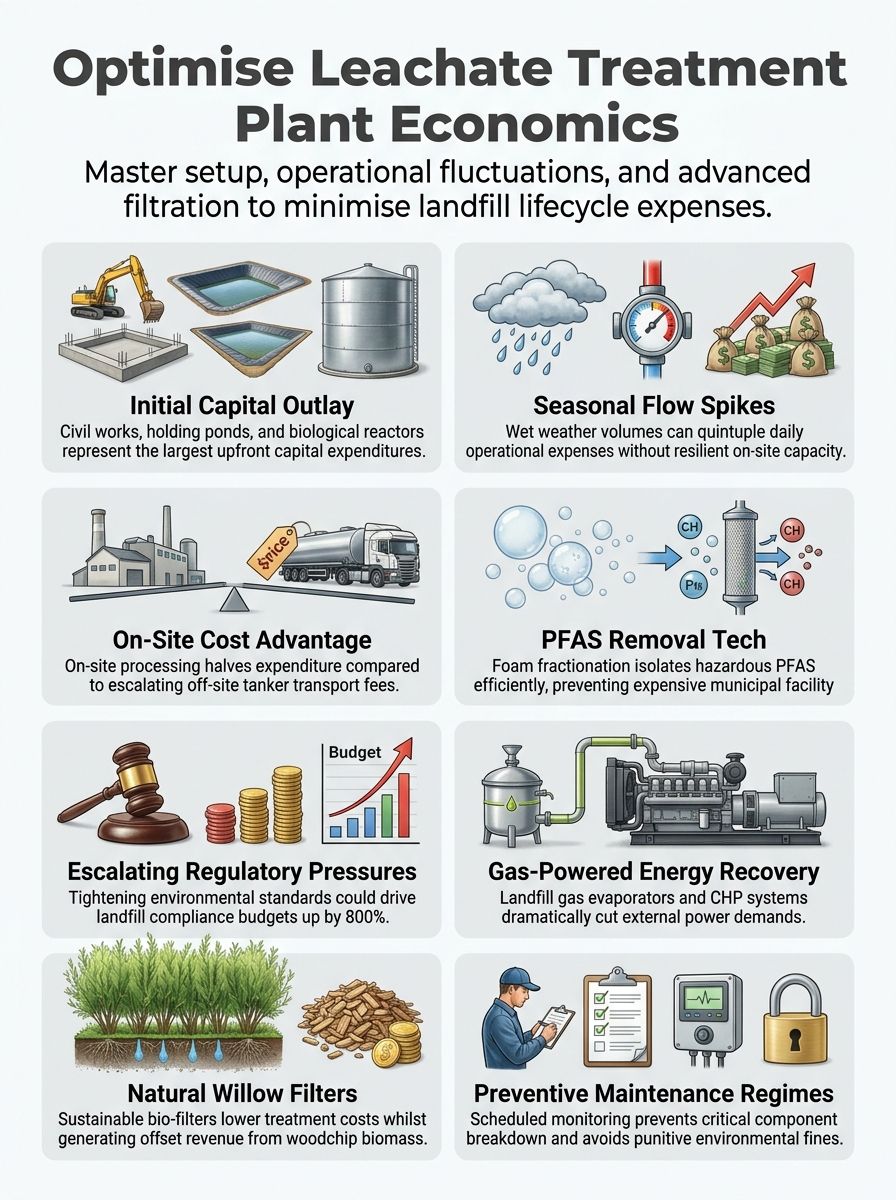
- Leachate management can consume 20–30% of a landfill’s total operations and maintenance budget in temperate climates — leachate treatment plant pricing is highly significant to the total costs of a landfill, and those costs don’t stop when the landfill closes.
- On-site treatment is often cost-competitive with hauling, especially as fuel prices and disposal surcharges continue to climb.
- Treatment technology choice is everything — MBR with reverse osmosis runs $0.064–$0.095 per gallon, while conventional activated sludge with RO can cost $0.25–$0.35 per gallon for the same outcome.
- Emerging contaminants like PFAS are quietly reshaping long-term leachate budgets — keep reading to understand what that means for your facility’s financial planning.
- Site-specific conditions, leachate volume, and discharge destination are the three variables that will define your total cost picture more than any other factor.
Leachate treatment is the cost that keeps coming — long after the gates close, the tipping fees stop, and the landfill is capped.
For waste management professionals making decisions about infrastructure investments, disposal contracts, or post-closure financial assurance, understanding what drives leachate treatment plant costs is not optional. It’s the difference between a budget that works and one that quietly bleeds for decades. Tetra Tech, a firm with deep experience in solid waste and environmental engineering, regularly helps landfill operators navigate exactly these kinds of decisions — from technology selection to long-term cost modeling.
Leachate Management Is Your Landfill’s Biggest Long-Term Bill
Most landfill operators know leachate is expensive. Fewer realize just how dominant it becomes in the overall cost structure over time. In temperate climates — where rainfall is consistent and infiltration into waste cells is ongoing — leachate management routinely accounts for 20 to 30 percent of total operations and maintenance expenditures. That’s not a line item. That’s a budget category that demands its own strategy.
What makes this especially challenging is the timeline. Leachate generation doesn’t peak and disappear. It persists well into the post-closure period, often for decades, continuing to require active collection, treatment, and disposal long after a facility has stopped accepting waste. Financial assurance calculations that underestimate this reality create serious compliance and cash flow problems down the road.
Why Leachate Costs 20–30% of O&M in Temperate Climates
The connection between climate and leachate cost is direct. In temperate regions, consistent precipitation means consistent leachate generation — there’s no dry season that gives the system a break. Operators must size treatment capacity for peak wet-weather flow events, which pushes capital costs up, and then run those systems year-round, which drives energy and chemical costs continuously. For those interested in understanding treatment options, consider exploring MBT leachate management treatment options.
Compare that to semi-arid or arid environments where evaporation can offset a significant portion of leachate volume, and the cost gap becomes clear. Climate isn’t the only driver, but in temperate zones, it sets the floor for what you’re going to spend.
How Ammonia, BOD, and Emerging Contaminants Drive Costs Up
Leachate composition is what turns a manageable treatment situation into a complex, expensive one. High ammonia concentrations are particularly problematic — small treatment plants often set ammonia limits at just 25 to 30 mg per liter, and hitting those limits requires either biological nitrification systems or additional pre-treatment steps. For more information on treatment methods, you can explore the differences between biological and chemical leachate treatment. Miss the limit, and you’re looking at surcharges, permit violations, or losing your discharge agreement entirely.
Biological oxygen demand (BOD) adds another layer. Facilities accepting leachate at a publicly owned treatment works (POTW) are often charged on a strength-based surcharge system, meaning that higher BOD in your leachate equals a higher bill — sometimes dramatically so. Add emerging contaminants like PFAS to the mix, and treatment complexity (and cost) only increases further.
On-Site Treatment vs. Hauling: Which Is Actually Cheaper
The honest answer: it depends on your volume, your site location, and what disposal options are realistically available to you. But the trend is clear — hauling is becoming less predictable and more expensive. Fuel price volatility, increasing truck traffic costs, and tightening acceptance criteria at receiving POTWs are all pushing the economics toward on-site treatment for many operators.
On-site treatment gives you cost control that hauling simply can’t match. When you own the treatment process, you’re not subject to surcharge changes, hauling rate increases, or a POTW deciding they no longer want your leachate. For facilities generating significant leachate volumes, on-site treatment is frequently cost-competitive — and increasingly, it’s the smarter long-term bet.
Leachate Treatment Plant Setup Costs
Capital investment in a leachate treatment plant is a major decision, and the range of costs is wide enough that “it depends” is genuinely the honest starting point. What you’re building, where you’re building it, and what your discharge requirements are will shape the capital number more than almost anything else.
Capital Costs by Treatment Technology
Not all leachate treatment technologies are created equal in terms of upfront cost or long-term performance. The core choice — biological treatment alone, biological treatment with membrane separation, or full advanced treatment with reverse osmosis — determines both your capital outlay and your operating cost structure for the life of the system.
Facilities that discharge to a POTW rather than directly to surface water have an important cost advantage: they require smaller reactor volumes and lower aeration capacity. That translates directly into lower capital costs. Facilities that must meet surface water discharge standards face stricter effluent requirements, which typically demands more treatment stages and higher upfront investment.
Biological SBR with Extended Aeration
Sequencing batch reactors (SBRs) with extended aeration are one of the more established approaches for leachate biological treatment. They handle BOD and ammonia removal effectively in a single reactor vessel, which simplifies the treatment train and can reduce both capital and footprint requirements compared to multi-stage continuous flow systems.
The tradeoff is operating cost. Extended aeration is energy-intensive, and aeration typically represents the largest single energy draw in a biological leachate treatment system. For facilities where electricity costs are high or leachate volumes are large, this becomes a significant recurring expense that needs to be modeled carefully in the total cost of ownership analysis.
Membrane Bioreactor (MBR) vs. Biological SBR with Extended Aeration: Cost Comparison
MBR systems combine biological treatment with membrane filtration in a single process, producing a higher quality effluent than conventional activated sludge or SBR systems alone. That quality advantage comes at a cost — both in capital and in membrane maintenance and replacement over time. However, the effluent quality from MBR often reduces or eliminates the need for downstream polishing steps, which can offset some of that premium. For more insights, explore the differences between biological and chemical leachate treatment.
When to Add Reverse Osmosis to Your Treatment Train
Reverse osmosis (RO) is the high-performance option — and the high-cost one. It’s typically added when effluent quality requirements are strict, when leachate contains high concentrations of dissolved solids, or when emerging contaminants like PFAS require near-complete removal. The question isn’t whether RO works — it does — but whether the effluent quality it delivers is actually required by your permit.
Adding RO to an MBR system brings marginal disposal costs to $0.064–$0.095 per gallon for on-site discharge scenarios. Adding RO to a conventional activated sludge system is significantly more expensive, ranging from $0.25 to $0.35 per gallon — a cost difference that makes technology selection a critical financial decision, not just an engineering one.
Before specifying RO, operators should confirm their actual discharge requirements. Over-treating leachate is expensive, and facilities that are discharging to a POTW often don’t need the effluent quality that RO provides — meaning the capital and operating premium doesn’t buy them anything in terms of compliance.
| Treatment Technology | Disposal to POTW ($/gal) | On-Site Discharge ($/gal) | Tanker Truck Disposal ($/gal) |
|---|---|---|---|
| Disposal via Tanker Truck Only | $0.039 | $0.125 | — |
| Membrane Bioreactor (MBR) | $0.033–$0.040 | $0.040–$0.065 | — |
| Conventional Activated Sludge (CAS) | $0.033–$0.039 | $0.035–$0.076 | — |
| MBR with Reverse Osmosis (RO) | — | $0.064–$0.095 | — |
| CAS with Reverse Osmosis (RO) | — | $0.250–$0.350 | — |
| Source: Marginal leachate disposal cost data from landfill O&M cost analysis research. Costs reflect marginal disposal costs per gallon across treatment scenarios. |
Site Conditions That Inflate or Reduce Setup Costs
The technology you choose sets the baseline, but site conditions determine whether you hit that baseline or blow past it. Soil conditions, available land area, proximity to electrical infrastructure, elevation, and the distance to the nearest POTW or discharge point can all meaningfully shift your capital cost — sometimes by a significant margin. A system that costs X to build on a well-prepared, accessible site can cost considerably more on a remote or geologically challenging one.
Day-to-Day Operating Costs
Capital costs get the attention during the planning phase, but operating costs are what actually determine whether a leachate treatment system is financially sustainable over its full service life. For most facilities, the gap between a well-optimized system and a poorly matched one shows up most clearly in the monthly operating bill — not the construction invoice. Understanding the treatment options for leachate management can significantly impact these costs.
Operating costs for leachate treatment break down into three primary categories: energy, chemicals and maintenance, and regulatory compliance costs including POTW surcharges. Each one is manageable with the right system design, but each one can also spiral if the treatment technology wasn’t matched carefully to the site’s actual leachate characteristics and discharge requirements.
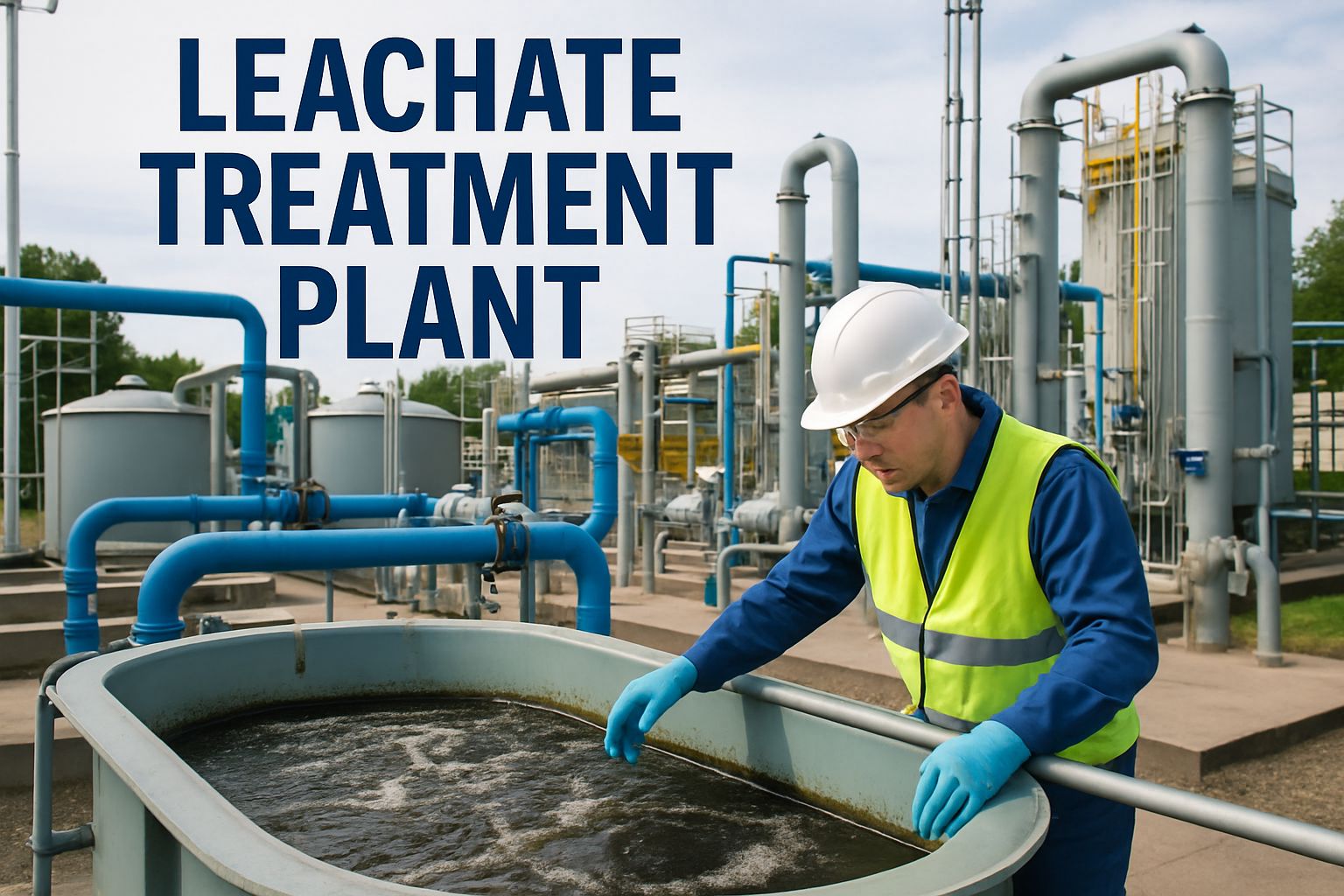
Energy Consumption as a Major Leachate Treatment Plant Pricing Driver
Aeration is the engine of biological leachate treatment — and it’s the largest single energy consumer in most systems. Whether you’re running a sequencing batch reactor, a conventional activated sludge system, or an MBR, the blowers and diffusers that deliver oxygen to the biological process run continuously, and electricity costs accumulate fast. For high-volume facilities, energy can represent the dominant operating expense, sometimes exceeding chemical and labor costs combined.
The energy intensity of a given system scales with both leachate volume and leachate strength. High-ammonia leachate requires more oxygen for nitrification, which means more aeration runtime and higher kilowatt-hour consumption per gallon treated. Facilities that don’t account for seasonal leachate strength variation in their energy budgets often find themselves over- or under-running aeration systems — both of which carry cost penalties.
- Blower and diffuser systems — typically the largest electrical load in a biological treatment plant
- Membrane filtration systems — MBR membranes require continuous recirculation pumping and periodic backwash cycles
- Reverse osmosis high-pressure pumps — energy-intensive by design, contributing significantly to per-gallon operating costs when RO is included
- UV disinfection or advanced oxidation — added energy loads when polishing steps are required for surface water discharge
- Heating systems — biological treatment performance drops in cold climates, requiring influent heating to maintain microbial activity in winter months
Facilities in cold climates face an additional energy burden that warmer-region operators often overlook: maintaining biological process temperatures in winter. Microbial activity — and therefore treatment performance — declines sharply in cold conditions, and heating influent leachate or insulating reactor vessels adds meaningful energy cost that needs to be built into the operating budget from day one. For more information on biological treatment performance, visit our detailed guide.
Chemical Dosing, Maintenance, and Labor Costs
Chemical costs in leachate treatment typically include pH adjustment reagents, nutrients to support biological processes when leachate is nutrient-deficient, coagulants and flocculants for solids management, and anti-scalants for RO membranes. Membrane systems carry an additional maintenance cost category — periodic chemical cleaning to maintain flux rates, and eventual membrane replacement, which for RO elements typically occurs on a three-to-five year cycle depending on leachate fouling characteristics. Labor requirements vary significantly based on system automation level, but even highly automated systems require skilled operators for monitoring, troubleshooting, and regulatory reporting.
POTW Surcharges and Pretreatment Compliance Costs
Discharging to a POTW is often the lowest-capital-cost disposal pathway, but it’s not a fixed cost — and that’s where many operators get caught off guard. POTW surcharge structures are based on the strength of the waste you’re sending, measured against baseline domestic wastewater concentrations. Leachate that exceeds POTW thresholds for BOD, ammonia, total suspended solids, or other parameters triggers surcharges that can substantially increase the effective per-gallon disposal cost over time.
Pre-treatment requirements add another layer. If your leachate contains constituents that the POTW can’t handle or that interfere with their process — certain metals, PFAS, or high ammonia concentrations — you may be required to pre-treat before discharge. The cost of that pre-treatment must be factored into the total POTW disposal cost, not treated as a separate line item. Some facilities find that once pre-treatment requirements are fully costed, on-site treatment to surface water discharge standards is actually more economical.
Small POTWs are particularly restrictive on ammonia — limits of 25 to 30 mg per liter are common at smaller plants — because their biological process has limited capacity to handle additional nitrogen loads. If your leachate regularly exceeds those thresholds, you’re either paying surcharges, investing in pre-treatment, or risking your discharge agreement. None of those outcomes is free.
Marginal Disposal Costs by Treatment Method
When comparing leachate management options, marginal disposal cost per gallon is the most useful common unit. It accounts for both the capital investment (amortized over the system’s service life) and the operating costs, giving you a true apples-to-apples comparison across very different treatment approaches and disposal pathways.
Cost Per Gallon: On-Site vs. POTW Disposal vs. Tanker Truck Hauling
Tanker truck hauling, at first glance, looks like the low-commitment option — no capital investment, no treatment system to operate, just a per-load hauling contract. But the marginal cost data tells a different story. Disposal via tanker truck runs approximately $0.125 per gallon when all costs are accounted for, making it consistently more expensive than on-site biological treatment in most volume scenarios. That cost is also the least controllable, tied directly to fuel prices, hauling distances, and the acceptance criteria of the receiving facility.
On-site biological treatment — whether MBR or conventional activated sludge — delivers marginal costs in the $0.033 to $0.076 per gallon range depending on the technology and the discharge destination. Facilities discharging to a POTW benefit from lower treatment requirements and therefore lower operating costs, while those discharging to surface water need more robust treatment and see higher per-gallon costs. The gap between hauling and on-site treatment widens as leachate volume increases, which is exactly why high-volume facilities almost universally favor on-site systems.
MBR With Reverse Osmosis: $0.064–$0.095 Per Gallon Explained
MBR with RO is the performance tier of leachate treatment — it delivers some of the highest effluent quality available from a biological-plus-membrane system, and it carries a cost premium that reflects that capability. The $0.064–$0.095 per gallon range for on-site discharge scenarios accounts for the higher capital cost of both the MBR membranes and the RO elements, plus the elevated energy costs from RO high-pressure pumping and the ongoing chemical cleaning and membrane replacement cycle.
That per-gallon cost is justified when your discharge permit actually requires the effluent quality that MBR plus RO delivers — particularly for surface water discharge with strict total dissolved solids, PFAS, or trace contaminant limits. Where it’s not justified is when a facility installs full MBR-RO capability to discharge to a POTW that would accept lower-quality effluent. Matching treatment intensity to actual permit requirements is where cost optimization begins.
Leachate Treatment Plant Pricing Snapshot: MBR + RO vs. Tanker Truck Hauling
At a facility generating 50,000 gallons per day of leachate:
• Tanker truck hauling at $0.125/gal = $6,250/day | $2.28M/year
• MBR with RO on-site at $0.095/gal = $4,750/day | $1.73M/year
• Estimated annual savings with on-site MBR+RO: approximately $550,000/yearNote: These figures are illustrative estimates based on published marginal cost data. Actual costs vary by site conditions, labor rates, energy costs, and local disposal markets.
The savings calculation above also doesn’t capture the volatility protection that on-site treatment provides. A hauling contract at $0.125 per gallon today isn’t guaranteed to stay there — fuel surcharges, driver shortages, and tightening disposal acceptance criteria can push that number significantly higher with limited notice. On-site treatment locks in a more predictable cost structure for the long term. For more insights on managing landfill leachate, check out Tetra Tech’s guide.
CAS With Reverse Osmosis: Why It Costs $0.25–$0.35 Per Gallon
Conventional activated sludge paired with reverse osmosis is the most expensive treatment combination in the leachate management toolkit, running $0.25 to $0.35 per gallon for on-site discharge scenarios. The cost premium comes from an inherent process mismatch: CAS effluent contains significantly higher suspended solids and biological carryover than MBR effluent, which means the RO membranes foul more rapidly, require more frequent chemical cleaning, and have a shorter effective service life. The result is dramatically higher membrane operating costs compared to MBR-RO for equivalent effluent quality.
In most cases, if you need the effluent quality that RO provides, MBR is the more economical biological pretreatment stage. The CAS-RO combination typically appears in legacy systems where a conventional activated sludge plant was retrofitted with RO to meet tightening discharge requirements — not as a new-build choice where the full treatment train can be optimized from the start.
Leachate Evaporation: A Niche but Viable Option
Evaporation-based leachate management is the option that rarely comes up in temperate climate discussions — because in those regions, it simply doesn’t work. But for landfills located in semi-arid and arid environments with sufficient available land, evaporation ponds represent a legitimate and sometimes cost-competitive alternative to biological treatment or hauling.
The fundamental principle is straightforward: leachate is conveyed to engineered ponds where it evaporates through a combination of natural solar energy and, in engineered systems, mechanical spray or misting equipment that increases surface area and accelerates evaporation rate. No biological treatment, no membranes, no chemical dosing — just physics, land, and in engineered systems, electricity for the spray systems.
The viability window for evaporation is defined by the ratio of evaporation rate to leachate generation rate. If your site generates more leachate than it can evaporate in a given period, the pond fills and you have a problem. That’s why this approach is functionally limited to arid and semi-arid climates where annual evaporation significantly exceeds annual precipitation — the inverse of temperate climate conditions.
Capital and O&M Costs of $0.08–$0.10 Per Gallon
Engineered evaporation systems carry capital and operations and maintenance costs in the range of $0.08 to $0.10 per gallon, with energy representing a large portion of that total — the spray or misting systems that drive evaporation efficiency are continuous consumers of electricity. That per-gallon cost is higher than basic biological treatment to a POTW, but for sites where POTW access is not available and hauling distances are long, it can be competitive with the alternatives actually available at that location.
When Evaporation Ponds Make Financial Sense at $0.02 Per Gallon
The long-term marginal cost picture for evaporation ponds is more attractive than the capital and O&M figure suggests. Across a 30-year service life, the marginal cost of evaporation pond management drops to approximately $0.02 per gallon — a figure that reflects the low ongoing chemical and mechanical maintenance costs once the pond infrastructure is in place. For more insights, consider getting a handle on landfill leachate.
Evaporation Pond: Long-Term Cost Profile
• Capital + O&M cost range: $0.08–$0.10 per gallon
• 30-year marginal cost: ~$0.02 per gallon
• Primary operating cost driver: Energy (spray/misting system electricity)
• Best-fit scenario: Semi-arid or arid climate, available land, no nearby POTW access
• Key limitation: Not viable where annual precipitation approaches or exceeds annual evaporation rate
Land availability is the other constraint that determines whether this option is even on the table. Evaporation ponds require meaningful acreage relative to leachate volume, and land at or near an active or closed landfill isn’t always available in the quantities required. Post-closure land use restrictions can further complicate the siting of new pond infrastructure after a facility has stopped accepting waste.
For the right site — arid climate, available land, remote location with limited POTW access — evaporation ponds deliver a genuinely low long-term cost structure with minimal mechanical complexity. For any other scenario, the limitations outweigh the economics, and biological treatment or hauling will deliver better overall value.
Long-Term and Post-Closure Cost Considerations
The financial obligation of leachate management doesn’t end when a landfill stops accepting waste — in many ways, that’s when the long-term cost picture becomes most critical to get right. Post-closure leachate generation continues for decades, driven by precipitation infiltrating through the final cover system and by ongoing decomposition of organic waste within the cells. Facilities that haven’t modeled this trajectory carefully often find that their post-closure cost estimates fall well short of actual expenditures.
Why Leachate Costs Continue Long After a Landfill Closes
Waste decomposition is a slow process, and the leachate it generates reflects that timeline. Even with an engineered final cover in place, some infiltration continues, and the biological activity within a closed landfill keeps producing leachate with elevated BOD, ammonia, and dissolved solids concentrations for years — sometimes for 20 to 30 years post-closure or longer depending on waste composition and climate. That means collection systems, treatment infrastructure, and disposal contracts must remain active and funded throughout the entire post-closure care period, which is typically a minimum of 30 years under federal Subtitle D requirements but often extends well beyond that in practice.
The treatment cost per gallon during post-closure often increases even as leachate volume gradually declines, because fixed infrastructure costs — debt service on capital equipment, labor, compliance monitoring — don’t scale down proportionally with volume. A treatment plant designed for peak operational-phase leachate flows becomes progressively oversized as post-closure generation rates drop, but it still costs money to operate, maintain, and permit. This fixed-cost dynamic is one of the most underestimated components of long-term leachate treatment plant pricing leachate budget planning.
PFAS and Emerging Contaminants: Budgeting for Future Compliance
PFAS — per- and polyfluoroalkyl substances — have fundamentally changed the long-term cost calculus for leachate management. These compounds, found in a wide range of consumer and industrial products that end up in municipal solid waste landfills, are extraordinarily persistent and mobile in leachate. They pass through conventional biological treatment systems largely unaffected, meaning that facilities currently operating MBR or conventional activated sludge systems may face significant capital reinvestment requirements as PFAS regulations tighten and discharge standards are enforced. For more insights, check out Tetra Tech’s perspective on landfill leachate management.
The EPA’s expanding list of unregulated contaminants under monitoring programs signals where enforcement attention is heading, and PFAS is at the top of that list. Reverse osmosis and certain advanced oxidation processes are among the more effective PFAS treatment approaches, but both carry substantial capital and operating cost premiums. Facilities that build long-term financial assurance estimates without a PFAS compliance scenario are taking on risk that regulators and lenders are increasingly unwilling to ignore. The smart approach is to model a PFAS treatment retrofit cost into post-closure financial planning now — even if the specific regulatory trigger hasn’t landed yet.
How Tightening Regulations Affect Long-Term Treatment Costs
Regulatory trajectory in leachate management has moved consistently in one direction: stricter standards, more parameters, and less flexibility at discharge points. POTWs that previously accepted leachate with minimal pre-treatment requirements are increasingly imposing ammonia limits, PFAS restrictions, and metals thresholds that require additional treatment steps before acceptance. Surface water discharge permits face similar pressure, with numeric effluent limits becoming more stringent as water quality standards are updated.
For long-term financial planning, this regulatory trajectory means that whatever treatment system you build today should be evaluated not just against current permit requirements, but against where those requirements are likely to go over the next 20 to 30 years. Building in treatment capacity and infrastructure flexibility — space for additional unit processes, electrical capacity for future equipment, modular system design — is a form of regulatory risk management that costs relatively little upfront and can save significantly when the next round of compliance requirements arrives. For more information on planning for future requirements, consider exploring MBT leachate management treatment options.
On-Site Treatment Protects You From Hauling Cost Volatility
The case for on-site leachate treatment isn’t purely about per-gallon cost comparisons — it’s also about risk management. Hauling contracts expose operators to fuel price fluctuations, driver and truck availability constraints, and the acceptance decisions of third-party receiving facilities. Any one of those variables can change with limited notice, leaving a facility scrambling for disposal alternatives or absorbing significant unbudgeted cost increases. Leachate recirculation, as one component of an on-site management strategy, also delivers a secondary financial benefit: cost-benefit analyses indicate a positive effect of approximately $0.005 per gallon through enhanced decomposition, increased landfill gas yield, and accelerated airspace recovery — meaning recirculation pays for itself and then some when properly implemented.
On-site treatment converts a variable, market-dependent cost into a more predictable, infrastructure-based one. The capital investment is real and front-loaded, but the operating cost per gallon is controllable in ways that hauling simply isn’t. For high-volume facilities operating over long time horizons — which describes most municipal solid waste landfills — that predictability has genuine financial value that belongs in the cost comparison alongside the raw per-gallon figures. Operators who invest in on-site treatment also position themselves ahead of future regulatory changes, with existing infrastructure that can be upgraded rather than built from scratch when new discharge requirements arrive.

Frequently Asked Questions About Leachate Treatment Plant Pricing
Below are direct answers to the questions waste management professionals ask most often when evaluating leachate treatment plant costs.
What Is the Average Cost Per Gallon to Treat Leachate On-Site?
On-site leachate treatment costs range from approximately $0.033 to $0.095 per gallon depending on the treatment technology and discharge destination. Membrane bioreactor systems discharging to a POTW sit at the lower end of that range ($0.033–$0.040/gal), while MBR with reverse osmosis for direct surface water discharge reaches $0.064–$0.095/gal. Conventional activated sludge with RO is the highest-cost combination at $0.25–$0.35/gal, and is generally only encountered in legacy retrofit situations rather than new builds. For more detailed insights, you can explore landfill leachate management.
Is It Cheaper to Haul Leachate or Treat It On-Site?
For most facilities generating significant leachate volumes, on-site treatment is cost-competitive with or less expensive than hauling when all costs are fully accounted for. Tanker truck disposal runs approximately $0.125 per gallon in marginal cost — higher than on-site biological treatment in most scenarios. Hauling costs are also variable and subject to fuel price increases, while on-site treatment provides a more predictable long-term cost structure. The break-even point depends on volume, hauling distance, and available disposal options, but the economics generally favor on-site treatment at higher generation volumes.
What Treatment Technology Is Most Cost-Effective for Leachate Management?
Membrane bioreactor (MBR) systems offer the best balance of effluent quality, operating cost, and long-term flexibility for most leachate management scenarios. For facilities discharging to a POTW, conventional activated sludge (CAS) can be similarly cost-effective at $0.033–$0.039/gal, but MBR’s superior effluent quality provides more regulatory headroom. The most cost-effective choice ultimately depends on your discharge permit requirements — over-treating leachate to meet a standard you’re not required to hit is a direct waste of capital and operating budget. For more information on treatment options, you can explore MBT leachate management treatment options.
How Do PFAS Contaminants Affect Leachate Treatment Plant Costs?
PFAS compounds pass through conventional biological treatment systems largely unaffected, meaning that existing MBR and activated sludge systems provide essentially no PFAS removal. As PFAS discharge standards are enforced — at both POTW acceptance points and surface water discharge permits — landfill operators will face capital reinvestment requirements to add PFAS-capable treatment steps. Reverse osmosis is among the more effective PFAS treatment technologies for leachate, but it carries significant capital and operating cost premiums. Facilities should model a PFAS compliance retrofit scenario into their long-term financial assurance planning, even where specific regulatory requirements are not yet finalized.
Do Leachate Treatment Costs Continue After a Landfill Closes?
Yes — leachate generation and the costs associated with managing it continue well into the post-closure period. Federal Subtitle D regulations require a minimum 30-year post-closure care period, and leachate generation routinely persists throughout that entire timeframe. Biological decomposition within closed waste cells continues producing leachate with elevated treatment-demanding constituents for years after final cover installation.
Post-closure leachate costs are also subject to a fixed-cost squeeze: treatment infrastructure designed for peak operational-phase flows becomes progressively oversized as generation rates decline, but fixed costs including equipment maintenance, labor, and regulatory compliance don’t scale down proportionally. This makes post-closure leachate one of the most financially significant long-term obligations a landfill operator carries, and one that demands careful modeling in any closure cost estimate or financial assurance instrument.
Leachate treatment plants play a crucial role in managing landfill leachate, ensuring that harmful substances are removed before they can contaminate groundwater or nearby water bodies. One of the key considerations in setting up such a plant is understanding the differences between biological and chemical leachate treatment methods. This knowledge can significantly impact the design, operation, and cost-effectiveness of the treatment process. By choosing the right treatment method, operators can optimize the performance of the plant and reduce long-term operational costs.