

Leachate Treatment
Leachate Treatment: Landfill Leachate Treatment Processes and Technologies
The processes which have been consistently successfully applied, for municipal waste landfill leachate from controlled landfills, are biological nitrification processes designed by specialist leachate process designers.
MBR Leachate Treatment System Pricing: Features, Capacity, and Operating Costs Compared
MBR leachate treatment systems have similar capital costs to FBBRs, but operating costs run higher at $10 per 1,000 gallons treated. While MBR systems boast superior effluent quality and TSS removal, understanding the long-term savings, particularly in sludge disposal, reveals their true value over time…
Reverse Osmosis vs. Evaporation for Leachate Volume Reduction: Performance and Cost Compared
Reverse osmosis and vacuum evaporation lead in leachate volume reduction. Evaporation preps RO treatment, enhancing efficiency. Lab tests show pollutant concentration with minimal transfer to distillate. Incorrect choices increase costs and risks, but combining both methods offers a comprehensive solution…
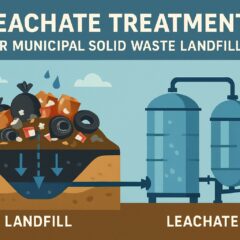
Biological vs. Chemical Leachate Treatment for Municipal Solid Waste Landfills: What Works Best
Landfill leachate is a complex wastewater requiring targeted treatment. Biological methods excel with biodegradable waste, while chemical processes handle heavy metals and recalcitrant organics. The best approach combines both to meet regulatory thresholds effectively, considering factors like leachate age and landfill stage for optimal results…
Activated Carbon vs. Ion Exchange Resin for Leachate Ammonia Removal: Efficiency and Cost
Ion exchange resins outperform activated carbon in ammonia leachate removal but at a cost. Zeolite is more economical, while activated carbon tackles both ammonia and organics. Choosing the right method hinges on leachate characteristics and treatment goals, making ion competition and cost crucial considerations…
MBT Leachate Management: Treatment Options, Compliance & Operational Costs
MBT leachate presents unique challenges with high ammonia, metals, and PFAS, necessitating multi-stage treatments. Effective systems blend biological and advanced oxidation techniques. Design is key to controlling costs and ensuring compliance, with research highlighting the Methane Phase Bed reactor’s role in optimal treatment solutions…
Glass Fused to Steel Tanks – Advantages and Disadvantages
Glass Fused to Steel Tanks (GFS) are popular for leachate treatment applications. However, they do have some negative characteristics. We thought it would be useful to discuss our view of GFS tanks. Read on to find out more! Introducing Glass Fused to Steel Tanks (GFS) CSTR biogas digester tank tanks are the most popular tank […]
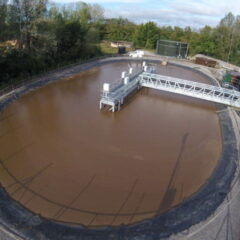
Efficient Aerators Key to Leachate Treatment Plant Refurbishment at Yorwaste’s Harewood Whin Landfill
At a recent Leachate Treatment Plant Refurbishment efficient aerators were needed to both fully mix and aerate the whole lagoon. In fact, consistently good mixing and oxygen transfer are always at the core of any successful aeration lagoon design. That’s where aerator and pump specialist Landia’s equipment has been used, and we are pleased to reproduce […]
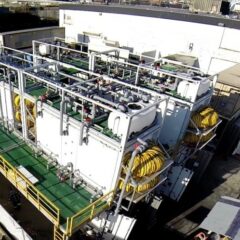
How to Treat Landfill Leachate Using a Saltworks Crystallizer System
Until now, the search for the perfect Leachate Treatment System has remained a dull one for those that know leachate. Somehow, all those contaminants it contains have contrived to make the most commonly used solutions highly complex, dependent on advanced technologies, and hard to operate successfully. Read about the new technology in the SaltMaker Evaporator Crystallizer, for something completely new!

Is Long-Term Recirculation Of Leachate Concentrate From Reverse Osmosis Treatment Sustainable?
The Reverse Osmosis process is unique, it alone consistently removes salts (salinity) from leachate, apart from prohibitively energy expensive, physical evaporative methods, so it is an obvious candidate for leachate treatment.