
On-Site vs. Off-Site Leachate Treatment: Key Takeaways:
- On-site leachate treatment outperforms off-site options on human health and cost metrics — but only when PFAS concentrations in leachate exceed 1,666 ng/L.
- Off-site treatment through municipal wastewater plants (POTWs) still holds an edge environmentally, but tightening PFAS discharge regulations are rapidly closing that window.
- The functional unit you use in a life cycle cost assessment changes everything — cost per m³ of leachate treated tells a very different story than cost per gram of PFAS removed.
- Landfills facing PFAS compliance pressure need to act now — WWTPs are already turning away high-concentration leachate, and the regulatory environment is only getting stricter.
- Not every on-site system is equal — reverse osmosis configurations, activated carbon adsorption, and ion exchange each carry distinct cost and performance trade-offs worth understanding before committing capital.
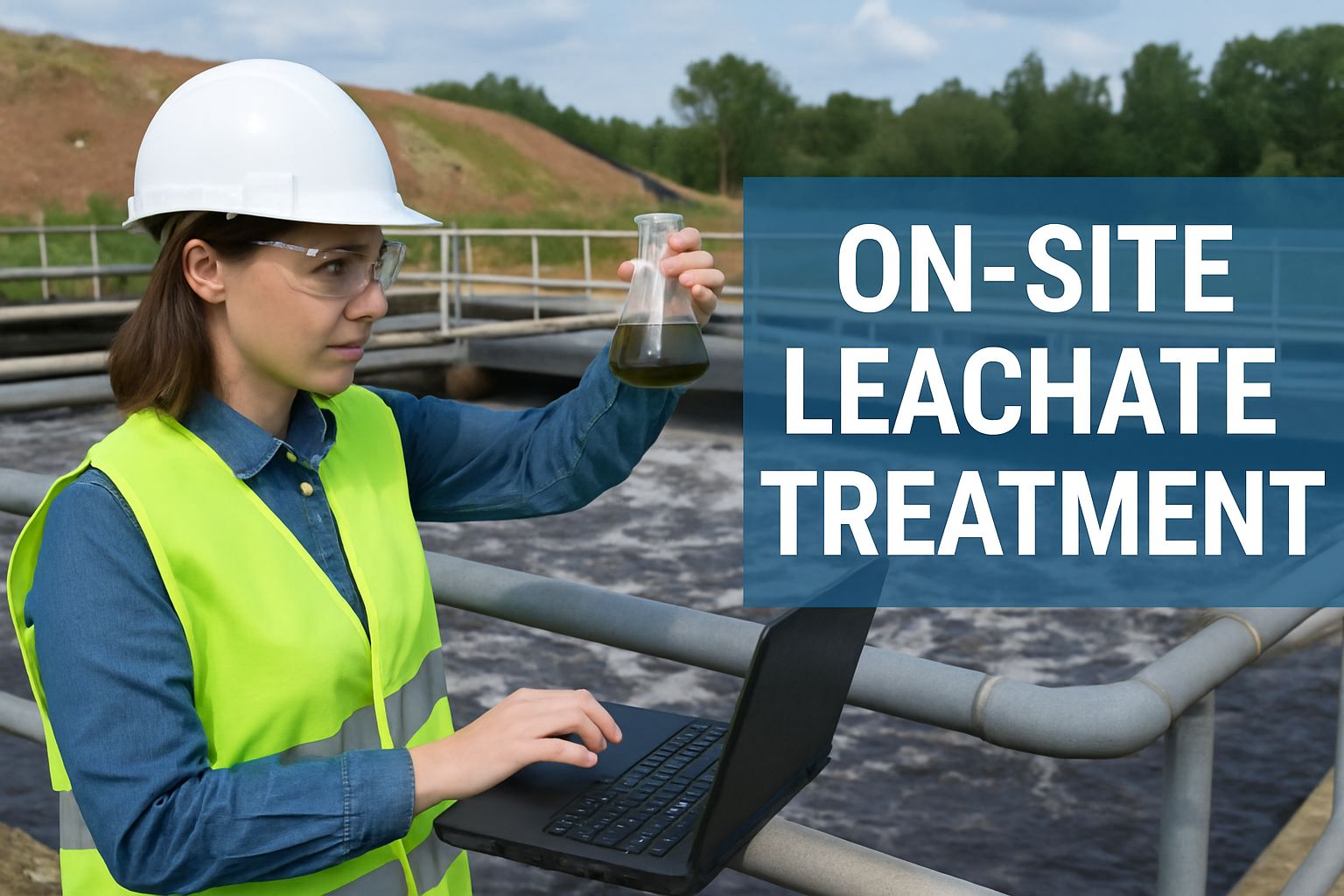
From an international perspective, in many nations the leachate treatment decision used to be straightforward — send it to the local wastewater plant and move on. That era is ending fast. (Individual national and local regulations vary. Always check your local regulator’s rules and guidance before proceeding.)
New PFAS discharge regulations are fundamentally changing how landfills manage leachate. Publicly owned treatment works (POTWs) that once accepted leachate without question are now rejecting high-concentration loads they can no longer legally process. For landfill operators and waste management decision-makers, this creates a pressing and expensive question: do you upgrade to on-site treatment, or find another off-site solution? The answer depends on your site’s PFAS concentrations, your capital budget, and what compliance framework you’re operating under.
Understanding both options in detail — their costs, their environmental trade-offs, and their regulatory viability — is exactly what this comparison covers. Resources like those focused on landfill leachate management are increasingly essential as the industry navigates this shift.
Leachate Treatment Is at a Crossroads
Landfill leachate has always been a management challenge, but PFAS contamination has elevated it to a compliance crisis. What was once a cost and logistics problem is now a regulatory liability that reaches across the entire leachate disposal chain — from the landfill gate to the receiving treatment plant and beyond.
Why Landfills Can No Longer Rely on POTWs Alone
For decades, the dominant approach to leachate management was co-treatment at municipal wastewater facilities. Landfills would haul leachate or pipe it directly to a nearby POTW, where it would be blended with municipal sewage and processed through conventional activated sludge systems. It was cost-effective, required no capital investment on the landfill’s part, and placed the treatment burden on a third party.
That model is now under serious strain. POTWs are not designed to handle the complex chemistry of landfill leachate — particularly its high ammonia loads, heavy metal content, and refractory organic compounds. More critically, conventional biological treatment does not destroy PFAS. It redistributes it. PFAS passes through activated sludge systems largely intact, ending up in effluent discharged to waterways or concentrated in biosolids that are then land-applied — creating a secondary contamination pathway that regulators are no longer willing to ignore.

“PFAS | US EPA” from www.epa.gov and used with no modifications.
How PFAS Regulations Are Forcing a Rethink
The U.S. EPA and equivalent regulatory bodies internationally have moved aggressively on PFAS in recent years. Proposed and finalized limits on PFAS in drinking water, surface water discharges, and biosolids are forcing POTWs to reconsider which industrial waste streams they accept. Landfill leachate — which can contain PFAS at concentrations orders of magnitude above drinking water limits — is increasingly being flagged as incompatible with POTW discharge permits. Learn more about how to treat landfill leachate effectively.
The consequences for landfills are direct and immediate:
- POTWs are issuing contract terminations or volume restrictions on leachate acceptance
- Hauling costs are increasing as fewer facilities will accept high-PFAS leachate
- Landfills face potential liability for PFAS contamination traced back to their leachate discharge
- Regulators are signaling that onsite PFAS treatment may become a permit requirement
- The window for low-cost offsite disposal is narrowing faster than most operators anticipated
This regulatory pressure is what’s driving the industry-wide conversation about on-site leachate treatment investment. But before evaluating that investment, it’s worth understanding exactly why leachate is so difficult — and expensive — to treat in the first place.
What Makes Leachate So Difficult to Treat
Leachate is not simply contaminated water. It is a highly variable, chemically complex liquid that changes in composition depending on the age of the landfill, the waste types accepted, precipitation patterns, and seasonal temperature shifts. No two leachates are identical, and that variability is precisely what makes treatment design so technically demanding.
Heavy Metals, Ammonia, and Refractory Organic Nitrogen
Young landfills typically produce leachate with high biological oxygen demand (BOD), volatile fatty acids, and elevated ammonia. As a landfill matures, BOD decreases but ammonia concentrations often remain persistently high — sometimes exceeding 1,000 mg/L — while the organic fraction shifts toward humic substances that are highly resistant to biological degradation. Heavy metals including lead, cadmium, chromium, and mercury can be present depending on historical waste acceptance practices.
Refractory organic nitrogen compounds are a particular challenge. Unlike simple ammonia, these compounds don’t respond predictably to conventional nitrification-denitrification processes, and they can interfere with biological treatment performance at receiving POTWs. This is one of the core technical reasons why co-treatment with municipal wastewater is increasingly problematic — leachate’s chemistry actively disrupts the microbial communities that make activated sludge systems work.
How Leachate Disrupts Municipal Wastewater Treatment Plants
When leachate enters a POTW at volume, it creates hydraulic and chemical loading spikes that the plant’s biological systems struggle to absorb. High ammonia loads can overwhelm nitrification capacity. Heavy metals at sufficient concentrations are toxic to the microbial biomass that drives biological treatment. The result is reduced treatment efficiency across the board — not just for leachate, but for the municipal wastewater being co-treated alongside it.
POTWs that accept leachate typically do so under strict volume and concentration limits set in their industrial pretreatment programs. But as PFAS detection capabilities have improved and regulatory scrutiny has intensified, those limits are being revised downward. What was an acceptable leachate load two years ago may now put the POTW’s own discharge permit at risk.
The practical implication for landfill operators is clear: even where a POTW relationship currently exists, it cannot be assumed to be stable. Planning around continued offsite disposal access is a risk management failure in the current regulatory environment.
The PFAS Problem: Concentrations Landfills Are Actually Dealing With
PFAS concentrations in landfill leachate vary enormously — from below 100 ng/L at some sites to well above 10,000 ng/L at others, depending on the types of waste historically accepted and the landfill’s age. Research has identified a critical threshold of 1,666 ng/L as the point at which on-site PFAS treatment becomes economically favorable compared to offsite alternatives. Below that threshold, the cost-per-gram of PFAS treated at an on-site facility becomes difficult to justify against hauling and co-treatment costs. Above it, on-site treatment wins on both cost and human health performance metrics.
“PFAS Sources – Enviro Wiki” from www.enviro.wiki and used with no modifications.
Off-Site Leachate Treatment: How It Works and Where It Falls Short
Off-site treatment remains the most common leachate management strategy in use today, particularly for smaller landfills that lack the capital or volume to justify on-site infrastructure. Understanding how it works — and where its limitations are most acute — is essential for any fair cost comparison.
The Traditional POTW Co-Treatment Model
In the standard off-site model, leachate is either hauled by tanker truck to a POTW or piped directly via dedicated conveyance infrastructure. At the POTW, it is blended with incoming municipal wastewater and processed through primary settling, activated sludge biological treatment, secondary clarification, and — in many facilities — UV disinfection or filtration before discharge. The landfill pays a tipping or acceptance fee, and the POTW assumes operational responsibility for treatment.
For conventional pollutants — BOD, suspended solids, nutrients — this model can be reasonably effective when leachate volumes are controlled and concentrations remain within the POTW’s pretreatment limits. The problems emerge with non-conventional contaminants like PFAS, where activated sludge provides essentially zero destruction and the POTW becomes an unintended redistribution point for persistent chemicals.
Environmental Performance of Off-Site Treatment
Life cycle assessment data comparing on-site and off-site treatment scenarios shows that off-site treatment generally performs better on aggregate environmental impact metrics when the functional unit is volume of leachate treated (per m³). This counterintuitive finding is driven largely by the energy and chemical inputs required to operate on-site treatment systems — particularly high-pressure membrane systems like reverse osmosis — which carry significant upstream environmental burdens in their manufacturing, operation, and concentrate disposal.
However, this environmental advantage is sensitive to how the analysis is framed. When the functional unit shifts from volume treated to mass of PFAS removed per gram, the picture changes considerably. On-site systems designed specifically for PFAS destruction or capture achieve far better removal efficiency per gram of PFAS addressed than POTW co-treatment, which achieves negligible PFAS removal. The choice of functional unit in an LCA is not a neutral technical decision — it reflects assumptions about what the treatment system is actually being asked to accomplish.
Regulatory Pressure Limiting Off-Site Viability
The regulatory trajectory on PFAS is unambiguous. The U.S. EPA’s finalized maximum contaminant levels (MCLs) for PFAS in drinking water — set at 4 ng/L for PFOA and PFOS individually — have created a cascading compliance pressure that starts at the drinking water source and works backward through every discharge point in the water cycle. POTWs discharging to surface waters used as drinking water sources are now acutely aware that PFAS in their effluent creates measurable risk to downstream communities. Accepting landfill leachate with PFAS concentrations in the thousands of ng/L is increasingly incompatible with their own permit conditions and public accountability obligations.
On-Site Leachate Treatment: Systems, Costs, and Trade-Offs
On-site leachate treatment is not a single technology — it’s a system design challenge that requires matching treatment train components to the specific chemical profile of a given landfill’s leachate. Getting that match wrong means either under-treating the leachate (creating compliance failures) or over-engineering the system (creating unnecessary capital and operating costs). The three primary technology pathways that dominate current on-site installations are reverse osmosis membrane systems, granular activated carbon adsorption, and ion exchange resin systems — often deployed in combination rather than as standalone solutions.
Common On-Site Treatment Technologies: RO, Activated Carbon, and Ion Exchange
Reverse osmosis is the workhorse of on-site leachate treatment. High-pressure membranes reject a broad spectrum of contaminants — dissolved organics, heavy metals, ammonia, and PFAS — achieving removal efficiencies that conventional biological treatment cannot approach. A 3-stage RO configuration, which is common in sites with high total dissolved solids or complex leachate chemistry, can achieve PFAS removal rates exceeding 95%. The trade-off is concentrate management: RO systems produce a high-strength reject stream that must itself be disposed of, typically through deep well injection, evaporation, or further treatment — each carrying its own cost and regulatory implications.
Granular activated carbon (GAC) adsorption is particularly effective for PFAS capture and is often deployed as a polishing step downstream of biological or membrane treatment. GAC systems are well-understood, relatively straightforward to operate, and scalable — but they require periodic media replacement or regeneration, and spent carbon containing adsorbed PFAS must be managed as a hazardous-adjacent waste stream. Ion exchange resins, particularly single-use anion exchange resins (SIEX), offer high selectivity for long-chain PFAS compounds and have gained traction as a cost-effective PFAS treatment option in systems where RO is not the primary treatment mechanism.
Capital and Operating Cost Breakdown
On-site leachate treatment facilities represent a significant capital commitment. Depending on system complexity, leachate volume, and site-specific conditions, capital costs for full-scale on-site systems typically range from several hundred thousand dollars for simple evaporation or basic biological systems to multiple millions for integrated membrane-based systems with PFAS polishing. Operating costs — covering energy, chemical inputs, membrane replacement, concentrate disposal, and labor — are ongoing and often underestimated during the initial feasibility phase. Energy consumption for high-pressure RO systems in particular can be substantial, and electricity costs represent one of the largest line items in annual operating budgets for membrane-based facilities.
Human Health Performance Advantages of On-Site Treatment
Where on-site treatment consistently outperforms off-site alternatives is in human health impact metrics. Life cycle assessment data from studies using a landfill site in Zhuzhou, China as a testbed confirmed that at mean leachate PFAS concentrations, the on-site treatment scenario produced better human health outcomes than the offsite co-treatment scenario. The mechanism is straightforward: on-site systems with proper PFAS removal technology capture and contain PFAS before it can be redistributed through POTW effluent, biosolids land application, or surface water discharge. Containing the PFAS pathway at the source — the landfill — is fundamentally more protective than attempting to manage it downstream at a facility not designed for it.
When On-Site Treatment Loses Its Cost Advantage
The cost advantage of on-site treatment is not unconditional. The critical variable is PFAS concentration in the leachate. Research has identified 1,666 ng/L as the threshold below which on-site PFAS treatment becomes economically unfavorable relative to offsite alternatives. When leachate PFAS concentrations fall below this level, the cost per gram of PFAS treated at an on-site facility rises to the point where hauling and POTW co-treatment — even with its limitations — is the more defensible economic choice.
This threshold matters enormously for site-specific decision-making. A landfill that accepted PFAS-containing industrial waste, firefighting foam-impacted materials, or large volumes of consumer products will likely sit well above 1,666 ng/L. A landfill with a more restricted waste acceptance history may fall below it. Before committing capital to on-site infrastructure, a thorough leachate characterization program — including seasonal sampling across multiple years — is essential to establish where a site actually sits relative to this threshold.
LCA and LCCA: What the Data Actually Shows
- Life Cycle Assessment (LCA) evaluates environmental and human health impacts across the full treatment system — from energy and chemical inputs through to final discharge or disposal
- Life Cycle Cost Assessment (LCCA) quantifies total costs over the operational life of the system, including capital, operating, maintenance, and end-of-life costs
- Functional unit selection — whether analysis is conducted per m³ of leachate treated or per gram of PFAS removed — materially changes which treatment scenario appears more favorable
- Both tools together provide the most complete picture for decision-making, since a system that appears cost-effective on LCCA may carry hidden environmental liabilities that only surface in LCA
Applied to leachate treatment comparison, LCA and LCCA produce findings that are both clear in direction and nuanced in their implications. The data does not deliver a universal verdict in favor of either on-site or off-site treatment — it delivers a conditional answer that depends on site-specific parameters and what the analysis is designed to measure. For more insights into treatment options, explore MBT leachate management treatment options.
The study using the Zhuzhou landfill as a testbed compared a typical onsite treatment configuration against a typical offsite co-treatment scenario using both LCA and LCCA frameworks. The onsite configuration included multiple treatment stages with PFAS removal capability. The offsite configuration reflected conventional activated sludge co-treatment at a municipal POTW. Two functional units were evaluated: 1 m³ of leachate treated and 1 g of PFAS treated. These were not arbitrary choices — they reflect two genuinely different ways of framing what success looks like in leachate management.
What the data showed confirmed that neither scenario dominates across all metrics. Off-site treatment produced lower aggregate environmental impact per cubic meter of leachate processed. On-site treatment produced better human health outcomes and lower lifecycle costs per gram of PFAS removed at mean concentration levels. The divergence between these findings is not a flaw in the methodology — it reflects the genuine complexity of comparing systems that are optimized for different objectives.
Environmental Impact Comparison Between On-Site and Off-Site Scenarios
Off-site treatment’s environmental performance advantage is real but context-dependent. When measured per m³ of leachate treated, the offsite scenario generates lower environmental impact across categories including climate change, eutrophication, and acidification. This is primarily because the offsite scenario leverages existing POTW infrastructure — the environmental burden of building and operating that infrastructure is shared across the full municipal wastewater volume, with only a fraction attributed to leachate co-treatment. On-site systems, by contrast, carry the full environmental burden of their construction and operation attributed entirely to leachate treatment.
However, this calculation changes when PFAS removal effectiveness is factored into the environmental impact accounting. Off-site treatment’s apparent environmental efficiency is partly an artifact of the fact that it doesn’t actually remove PFAS — it relocates it. The PFAS that passes through the POTW and enters receiving waterways, or concentrates in biosolids, carries downstream environmental impacts that are not fully captured in a straightforward LCA comparison. A more complete environmental accounting would attribute those downstream PFAS exposure pathways back to the treatment scenario that failed to address them.
How Functional Units Change the Outcome of the Analysis
The choice between using 1 m³ of leachate treated versus 1 g of PFAS treated as the functional unit is not merely a methodological detail — it fundamentally reframes the question being asked. Per cubic meter, off-site treatment appears more efficient because it processes large volumes at relatively low incremental cost by leveraging shared infrastructure. Per gram of PFAS removed, on-site treatment wins decisively because off-site treatment achieves negligible PFAS removal, making its cost-per-gram-removed effectively infinite for this specific contaminant. Decision-makers should be deliberate about which functional unit reflects their actual regulatory and operational objective before accepting any cost comparison at face value.
The PFAS Concentration Threshold That Makes On-Site Treatment Unviable
The 1,666 ng/L threshold identified in the research represents the inflection point where on-site treatment’s cost advantage disappears. Below this concentration, the capital and operating costs of on-site PFAS-capable treatment systems cannot be justified purely on economic grounds relative to continued offsite disposal — assuming offsite disposal remains available. Above it, on-site treatment delivers better cost performance per gram of PFAS treated and substantially better human health outcomes. For landfill operators, this number should be a standing reference point in any leachate management planning conversation.
Compliance Feasibility: Choosing the Right Approach for Your Landfill
Choosing between on-site and off-site leachate treatment is not purely a technology decision — it’s a compliance, financial, and operational risk decision that needs to be made with a clear picture of your site’s specific circumstances. The analysis that works for a large municipal landfill accepting diverse industrial waste streams will look completely different from what’s appropriate for a smaller construction and demolition facility with limited PFAS exposure history.
- Current PFAS concentrations in your leachate — measured across seasons and waste zones
- Whether your current POTW acceptance agreement is at risk of revision or termination
- Your landfill’s projected operational life and remaining waste capacity
- Available land area and infrastructure for on-site treatment construction
- Local discharge permit conditions and receiving water quality standards
- Concentrate disposal options if reverse osmosis is under consideration
Each of these factors directly affects which treatment pathway makes financial and regulatory sense. A landfill with only five years of remaining operational life may find it difficult to amortize the capital cost of a full on-site treatment facility across a short enough timeframe to justify the investment. Conversely, a landfill with 20-plus years of projected operation and rising PFAS leachate concentrations has every reason to move toward on-site infrastructure now rather than face regulatory enforcement later.
Treatability studies — including bench-scale and pilot-scale testing — are not optional for sites seriously evaluating on-site treatment. Leachate characterization data from a single sampling event is insufficient for design purposes. Multi-season sampling that captures the variability in organic loading, ammonia, metals, and PFAS concentrations is the minimum data foundation for any credible feasibility analysis. Proper characterization backed by treatability studies is widely recognized in the industry as a prerequisite for sound on-site leachate treatment system design.
The interaction between leachate characteristics and discharge options also shapes what technology configuration is appropriate. A site with access to a sanitary sewer for treated effluent discharge operates under different constraints than one that must meet direct surface water discharge standards. Surface water discharge permits are typically far more stringent, which may require additional treatment stages — and additional capital — beyond what a sewer discharge scenario would demand.
Regulatory Factors That Should Drive Your Decision
The regulatory environment around PFAS is moving quickly, and waiting for final rules before beginning planning is a losing strategy. The U.S. EPA’s finalized MCLs for PFOA and PFOS at 4 ng/L in drinking water have already created downstream pressure on POTW discharge permits. Effluent limitation guidelines specific to landfill leachate discharge are in active development, and early indications suggest they will impose meaningful PFAS removal requirements. Landfills that begin their feasibility work now — even before final rules are published — will be far better positioned than those that wait for regulatory certainty that may arrive with enforcement teeth attached.
State-level regulations add another layer of complexity. Several states have moved ahead of federal standards on PFAS, and landfill operators in states including Michigan, Minnesota, and Massachusetts are already navigating leachate PFAS requirements that exceed federal baselines. Understanding both your current state regulatory framework and the direction it is likely to move over your landfill’s remaining operational life is essential context for any treatment investment decision.
Site-Specific Considerations That Affect Feasibility
Beyond regulation, the practical feasibility of on-site treatment hinges on site-level variables that no generic cost comparison can fully account for. Available land area for treatment infrastructure, proximity to electrical grid capacity, depth to groundwater affecting construction options, local labor market conditions for operations staffing, and the specific chemistry of your leachate all factor into what a real on-site system would cost and perform like at your specific location. A detailed site assessment — not a desk study — is the only reliable basis for a capital commitment of this scale.
On-Site Treatment Is Winning — But Not for Every Landfill
The weight of current evidence — from life cycle assessments, cost analyses, and the direction of PFAS regulation — points toward on-site treatment as the more defensible long-term strategy for landfills with PFAS concentrations above 1,666 ng/L and meaningful operational life remaining. It delivers better human health outcomes, stronger cost performance per gram of PFAS removed, and eliminates the growing liability of depending on POTWs that are themselves under regulatory pressure. But it is not a universal answer. Sites with low PFAS concentrations, short remaining operational lives, or limited capital access may find that optimized offsite management — combined with aggressive leachate characterization and regulatory engagement — remains the appropriate near-term path. The decision demands site-specific data, not industry-wide generalizations.
Frequently Asked Questions
Leachate treatment decisions involve regulatory, technical, and financial considerations that don’t always have clean answers. The questions below address the points that come up most frequently among landfill operators and waste management decision-makers working through this issue. For more insights, you can explore onsite leachate treatment systems to understand their cost and environmental impact.
Before diving into specific questions, it helps to understand the core framework. Three variables drive almost every leachate treatment decision:
- PFAS concentration — the primary chemical driver of whether on-site treatment is economically justified
- Regulatory trajectory — both current requirements and where standards are headed over your operational horizon
- Operational life remaining — the timeframe over which capital investments must be amortized
With those anchors in mind, here are the specific questions that matter most.
What is the main difference between on-site and off-site leachate treatment?
On-site treatment means building and operating leachate treatment infrastructure directly at the landfill, allowing effluent to be discharged to a sewer or surface water without hauling. Off-site treatment means transporting leachate — by truck or pipeline — to a municipal wastewater treatment plant (POTW) where it is co-treated with municipal sewage. The core difference in the current regulatory environment is PFAS removal: on-site systems can be designed specifically for PFAS capture and destruction, while POTW co-treatment provides negligible PFAS removal and increasingly creates compliance problems for the receiving facility.
Why are POTWs becoming less willing to accept landfill leachate?
POTWs are facing their own PFAS compliance pressure. As the U.S. EPA finalizes PFAS limits in drinking water and develops effluent limitation guidelines for wastewater discharges, POTWs that accept high-PFAS leachate are finding that their own discharge permits are at risk. PFAS passes through activated sludge treatment largely intact, meaning it either discharges with the POTW’s effluent into receiving waterways or concentrates in biosolids that are land-applied — both of which are now under intense regulatory scrutiny. Accepting landfill leachate with PFAS concentrations in the thousands of ng/L is a liability that growing numbers of POTWs are no longer willing to carry.
At what PFAS concentration does on-site leachate treatment become the better option?
Research comparing on-site and off-site leachate treatment scenarios identified 1,666 ng/L as the critical threshold. Above this concentration, on-site treatment delivers better cost performance per gram of PFAS treated and superior human health outcomes compared to offsite co-treatment. Below this level, the economics of on-site PFAS treatment become difficult to justify against the lower capital cost of continued offsite disposal — assuming offsite disposal access remains available. This threshold should inform leachate characterization programs at any site evaluating a treatment pathway decision.
What on-site leachate treatment technologies are most effective for PFAS removal?
The three primary technology pathways for PFAS removal in on-site leachate treatment are reverse osmosis membrane systems, granular activated carbon (GAC) adsorption, and ion exchange resins — most commonly single-use anion exchange (SIEX) resins. Each addresses PFAS through a different mechanism and carries distinct cost and operational implications. For more insights on on-site leachate treatment systems, explore further resources.
Reverse osmosis is the most broadly deployed technology for full leachate treatment, achieving PFAS removal efficiencies above 95% in 3-stage configurations. It rejects a wide range of contaminants simultaneously — dissolved organics, metals, ammonia, and PFAS — making it a comprehensive treatment solution. Its primary challenge is concentrate management: the high-strength RO reject stream requires its own disposal pathway, typically deep well injection or evaporation, which adds cost and regulatory complexity.
GAC and ion exchange are more commonly deployed as polishing stages following primary biological or membrane treatment, targeting residual PFAS that passes through upstream processes. GAC systems are well-established and scalable but require periodic media replacement or regeneration. SIEX resins offer high selectivity for long-chain PFAS compounds and have emerged as a cost-competitive option for sites where RO is not the primary treatment mechanism. The choice between these technologies — or a combination of them — should be driven by leachate-specific treatability study results rather than generic technology preference.
How do life cycle assessment results differ between on-site and off-site leachate treatment?
Life cycle assessment results for on-site versus off-site leachate treatment are not uniform — they depend significantly on which functional unit is used to frame the analysis. When the comparison is conducted per cubic meter of leachate treated, off-site treatment generally produces lower aggregate environmental impact because it leverages existing POTW infrastructure whose environmental burden is distributed across a large municipal wastewater volume. On-site systems carry the full construction and operational environmental burden attributed solely to leachate treatment.
When the functional unit shifts to per gram of PFAS removed, the result inverts. On-site systems designed for PFAS removal achieve meaningful capture and destruction of PFAS, while off-site co-treatment achieves negligible PFAS removal — making its cost and environmental performance per gram of PFAS addressed effectively non-competitive. The choice of functional unit is therefore not a neutral analytical decision; it reflects assumptions about what the treatment system is supposed to accomplish.
On human health impact metrics, on-site treatment consistently outperforms off-site alternatives at mean leachate PFAS concentrations. The mechanism is containment: on-site systems with proper PFAS removal technology prevent the redistribution of persistent chemicals through POTW effluent and biosolids pathways that represent ongoing human exposure risks.
The practical takeaway for decision-makers is to demand transparency about functional unit selection in any LCA or LCCA comparison presented to support a leachate treatment investment recommendation. A comparison framed per m³ treated will favor off-site treatment. A comparison framed per gram of PFAS removed will favour on-site treatment. Both are legitimate analytical frames — but only one reflects your actual regulatory obligation if PFAS compliance is the driver of the decision.
For landfill operators navigating this shift, working with specialists in leachate management strategy can accelerate the path from characterization data to a defensible treatment decision — visit this resource to explore what that looks like in practice.