


Leachate collection system pricing is an important element of total landfill development cost. Complete landfill leachate management and collection system installations typically range from $500,000 to over $3 million in capital expenditure (CAPEX) for US sanitary landfills, depending heavily on the size and footprint of the landfill site.
Article At A Glance – Leachate Collection System Pricing
- A complete leachate collection system — including HDPE pipe, sumps, pumps, and discharge lines — can run well into six figures before engineering and permitting fees are added.
- Pipe diameter, wall thickness, landfill depth, and liner integration are the four biggest variables that will swing your total pipe costs dramatically.
- Self-priming pumps consistently outperform submersible pumps on long-term maintenance costs, but the upfront comparison is more nuanced than most operators realize.
- Jet cleaning and pump extraction are ongoing costs that are frequently underbudgeted — and skipping them may lead to clogged pipes, immovable leachate, and regulatory headaches.
- Getting an accurate cost estimate requires a full design to be completed and a pipe and pump requirements schedule to be completed, including site-specific hydraulic modelling, not ballpark figures — keep reading to understand exactly what drives each line item.
Leachate collection system pricing is one of the most misunderstood cost categories in landfill design — and underestimating it creates problems that compound over the entire operational life of a facility.
Leachate is the liquid that forms when water filters through solid waste, picking up dissolved contaminants along the way. Capturing it before it migrates into surrounding soil and groundwater is not optional — it is a federal requirement under Subtitle D of the Resource Conservation and Recovery Act (RCRA) for municipal solid waste landfills.
The system that does this work involves perforated HDPE collection pipes, impermeable liner systems, collection sumps, riser pipes, pumps, discharge lines, and treatment or storage infrastructure. Every one of those components carries a price tag, and they add up fast. For waste management professionals looking for a starting framework, Geodsyn Tech provides engineering and environmental services that support leachate system design and compliance planning.
Leachate Collection System Costs Are Higher Than Most Engineers Expect
The budgeting shock usually hits during the detailed design phase. A basic leachate collection and removal system (LCRS) for a single lined disposal cell can easily exceed $500,000 when you factor in pipe materials, sump construction, pumping equipment, electrical infrastructure, monitoring and control systems, and engineering fees.
Larger multi-cell facilities or those in states with stringent composite liner requirements can push total system costs into the millions. The gap between initial budget estimates and final construction costs is almost always driven by underestimating the interaction between components — particularly how liner system geometry drives pipe route selection and sump design.
What Drives the Cost of an HDPE Pipe Leachate System
HDPE pipe is the dominant material for leachate collection systems because of its chemical resistance, flexibility, and long service life in aggressive leachate environments. But HDPE is not a single product — it comes in a wide range of diameters, wall thicknesses, and perforation patterns, and each specification choice has a direct cost consequence.
The pipe needs to be installed within permeable material, and to be a granular material must provide the capability to “arch” in a manner that avoids squashing the pipe once loaded by the waste above. Care is needed to estimate the adequate volume needed for such purposes.
Pipe Diameter and Wall Thickness Requirements
Pipe diameter in leachate collection systems is determined more by the need to provide sacrificial bore to allow for sediment and biological sludge build-up within the pipes. Hydraulic modelling takes a back seat but must show adequate capacity for maximum peak flows. The collection pipes must handle peak leachate generation rates according to the cellular layout design for progressive infilling — which depends on landfill surface area, precipitation, waste composition, and cover system permeability.
Common collection pipe diameters run from 4-inch for short lateral runs but rarely to 12-inch. As diameter increases, material cost per linear foot rises sharply, and that cost multiplies across thousands of linear feet of pipe installed throughout a disposal cell. To manage these costs effectively, it is crucial to implement strategies for minimising leachate generation in landfills.
Wall thickness is driven by the depth of waste above the pipe. However, much leachate collection system pipework is by necessity laid below the depth permissible according to the manufacturer’s tables. Landfill engineers have to understand and use the ability of flexible pipe to perform under great depths of waste by understanding arching, much in the same way that tunnellers use it in larger tunnels.
HDPE pipe used in leachate collection systems is rated by Standard Dimension Ratio (SDR), which expresses the ratio of outside diameter to wall thickness. Lower SDR numbers mean thicker walls and higher compressive strength — but also significantly higher cost. A pipe buried under 100 feet of waste requires a much lower SDR rating than one installed in a shallow cell, and that specification difference translates directly into cost both in pipe and in pipe surround materials.
Perforated vs. Solid HDPE Pipe Cost Differences
Within a leachate collection system, both perforated and solid HDPE pipe serve distinct roles. Perforated pipe — with slots or holes machined into the pipe wall — is used for the actual collection laterals where leachate needs to enter the pipe from the surrounding drainage layer. Solid pipe is used for transport runs, discharge lines from sumps, and any section where leachate containment rather than collection is the goal.
Perforated HDPE pipe typically costs more than solid pipe of the same diameter and SDR rating. The perforation process adds manufacturing cost, and perforated pipe is often specified with geotextile sock wrapping to prevent fine particles from entering and clogging the collection system — adding both material and installation labour costs.
How Landfill Depth Affects Pipe Length and Total Cost
Landfill depth is one of the most direct multipliers on total pipe cost. In a deep landfill with a perimeter berm configuration, the riser pipes that connect the base collection sump to the top of the berm can run to considerable lengths.
A 2-inch diameter solid HDPE discharge line will often be perfectly adequate to take the calculated maximum flow. But it is difficult to rod and jet, and will easily block with leachate. Therefore, a 4-inch minimum diameter for all leachate collection and pumping main pipe is the practical minimum.
The main riser pipes that need to be installed at multiple locations to reach from the sump bottom to the top of the perimeter berm in a deep cell add significant material cost — and create real operational challenges during pipe maintenance when technicians must jet-clean long, heavy pipe assemblies soiled with leachate and accumulated slime.
HDPE Pipe Pricing Breakdown for Leachate Collection
| Pipe Type | Diameter | SDR Rating | Estimated Cost Per Linear Foot | Typical Application |
|---|---|---|---|---|
| Solid HDPE | 4-inch | SDR 17 | $3 – $6 | Short lateral transport runs |
| Perforated HDPE | 4-inch | SDR 17 | $5 – $9 | Collection laterals in drainage layer |
| Solid HDPE | 6-inch | SDR 17 | $7 – $13 | Main collection trunk lines |
| Perforated HDPE | 6-inch | SDR 11 | $12 – $20 | High-load collection laterals |
| Solid HDPE | 12-inch | SDR 11 | $28 – $50+ | Primary trunk lines, deep cells |
| Solid HDPE (Discharge) | 2-inch | SDR 11 | $2 – $4 | Pump discharge lines from sump |
| Note: All our Leachate Collection System Pricings are general estimates and vary significantly by region, supplier, and project quantity. Always obtain current supplier quotes for budgeting purposes. |
Cost Per Linear Foot by Pipe Size
The table above gives a working framework, but the real cost driver is total installed length. A single disposal cell covering 10 acres with collection laterals spaced 50 feet apart can require 8,000 to 12,000 linear feet of perforated collection pipe before a single foot of trunk line or discharge pipe is added. At even moderate per-foot prices, that adds up to a substantial materials line item before pipe bedding or installation labor is calculated.
Fittings, Couplings, and Connection Costs
Fittings and couplings are frequently underestimated in preliminary budgets. HDPE leachate pipe systems use heat fusion connections — butt fusion or electrofusion — rather than mechanical couplings in most applications. The fittings themselves (tees, elbows, reducers, end caps) that are used to connect pumps and ancillaries such as valves and wash-out points carry a significant unit cost premium over straight pipe, and the fusion equipment and labour required to make and test each connection add to installation cost.
Budget at least 15% to 20% of raw pipe material cost for welding, fittings and connections on a typical leachate collection system.
How Liner System Integration Affects Pipe Costs
Leachate collection pipes do not sit in isolation — they are installed directly on top of the primary liner system above the protective geomembrane, which is typically a composite liner consisting of a geomembrane (usually 60-mil HDPE, US ) overlying compacted low-permeability soil or a geosynthetic clay liner (GCL).
Pipe installation must be carefully managed to avoid puncturing or damaging the liner, which often requires protective cushioning layers and specific bedding specifications.
These requirements add material and labour costs, and in many state-regulated facilities and the EU, they require third-party construction quality assurance (CQA) monitoring that adds further to project cost. For more detailed information on what leachate is, you can visit this resource.
Leachate Collection Sump Design and Construction Costs
The collection sump is the lowest point in the leachate collection system — the point where gravity has done its work and the accumulated leachate must be mechanically extracted. A typical sump configuration places a collection point inside the lined area at the toe of the landfill perimeter berm slope, with large-diameter riser pipes extending from the sump up to the top of the berm to provide pump access.
Sump construction leachate collection system pricing costs depend heavily on the size of the disposal cell, the depth of the sump below the perimeter berm crest, and the liner system configuration required at the sump location.
Sump Pit Excavation and Liner Installation
Sump pit construction requires excavating into the subgrade at the lowest elevation point of the disposal cell, then carefully installing the liner system through and around the sump structure without compromising liner integrity. The sump itself is typically formed using a large-diameter HDPE pipe section — often 24-inch to 48-inch diameter — oriented vertically to create the collection chamber. Liner penetrations at the sump require factory-fabricated HDPE boots or field-fabricated connections, both of which carry significant material costs and require CQA documentation.
Total sump construction costs, including excavation, liner work, granular drainage aggregate, and the sump structure itself, typically range from $15,000 to $60,000 or more per sump depending on depth, diameter, and site-specific liner requirements.
Riser Pipe Costs and Depth Considerations
Riser pipes may be constructed in lifts that follow the waste as filling dictates and, if so, are generally constructed in the same diameter as the sump at the base, or be retrofitted. Retrofitted leachate riser pipes are drilled from the final cell completion surface and are a smaller diameter, just wide enough to allow the pump body to be lowered. Retro-fitted riser pipes are not covered in this article.
Field Note: In a deep landfill cell where the perimeter berm crest sits 60 to 80 feet above the sump floor, riser pipe assembly becomes both a major cost item and a significant operational safety concern. Technicians performing pump maintenance must extract long, heavy pipe strings soiled with leachate and biological slime — a task that requires proper fall protection, confined space procedures, and mechanical lifting equipment. These operational realities should be factored into both the design and the long-term maintenance budget from day one.
Riser pipes are the vertical conduit connecting the sump at the base of the landfill to the working surface at the top of the perimeter berm. Large-diameter riser pipe manholes — typically 18-inch to 36-inch HDPE — provide the access pathway for pump equipment, while the inner discharge line (commonly 2-inch solid HDPE) runs through the riser to carry extracted leachate to the surface. The cost of the riser pipe assembly scales directly with landfill depth, and in facilities with a deep waste height, the riser pipe, protective casing, and associated anchor and support hardware can represent a significant share of total system cost.
Beyond material cost, riser pipe depth has a compounding effect on the entire pumping system design. Deeper risers mean longer discharge lines, which increases friction head losses and directly affects pump selection and motor sizing — both of which affect equipment cost.
A hydraulic engineer calculating total dynamic head for a pump in a 70-foot deep cell will arrive at very different equipment specifications — and costs — than one designing for a 25-foot cell, even if the leachate generation rates are identical. However, for most applications flow extracted over a long period will suffice using a smaller diameter pipe bore, as long as a self-cleaning velocity is still achieved at the pump pressure duty level.
When budgeting riser pipe costs, do not overlook the surface completion at the top of the berm. A proper riser completion includes a lockable access cover, surface drainage controls to prevent stormwater intrusion, and in many facilities, a secondary containment structure around the pump access point. These surface works add $2,000 to $8,000 per riser location depending on specification and local contractor pricing. For more detailed pricing information, you can explore leachate treatment plant pricing.
Leachate Pump Costs: Submersible vs. Self-Priming Systems
Pump selection is one of the most consequential cost decisions in leachate collection system design — not just for capital cost, but for the total cost of ownership over the operating life of the facility. The two dominant pump configurations used in landfill leachate removal are submersible pumps, which operate while fully submerged in leachate at the sump bottom, and on very rare occasions self-priming pumps, which are installed at the top of the perimeter berm and draw leachate up through the riser pipe via a rotating shaft or spindle that powers the pump mechanism below. Each approach has a distinct cost profile that plays out differently over time.
- Submersible pumps sit at the bottom of the sump, fully immersed in leachate, and push fluid up the discharge line to the surface
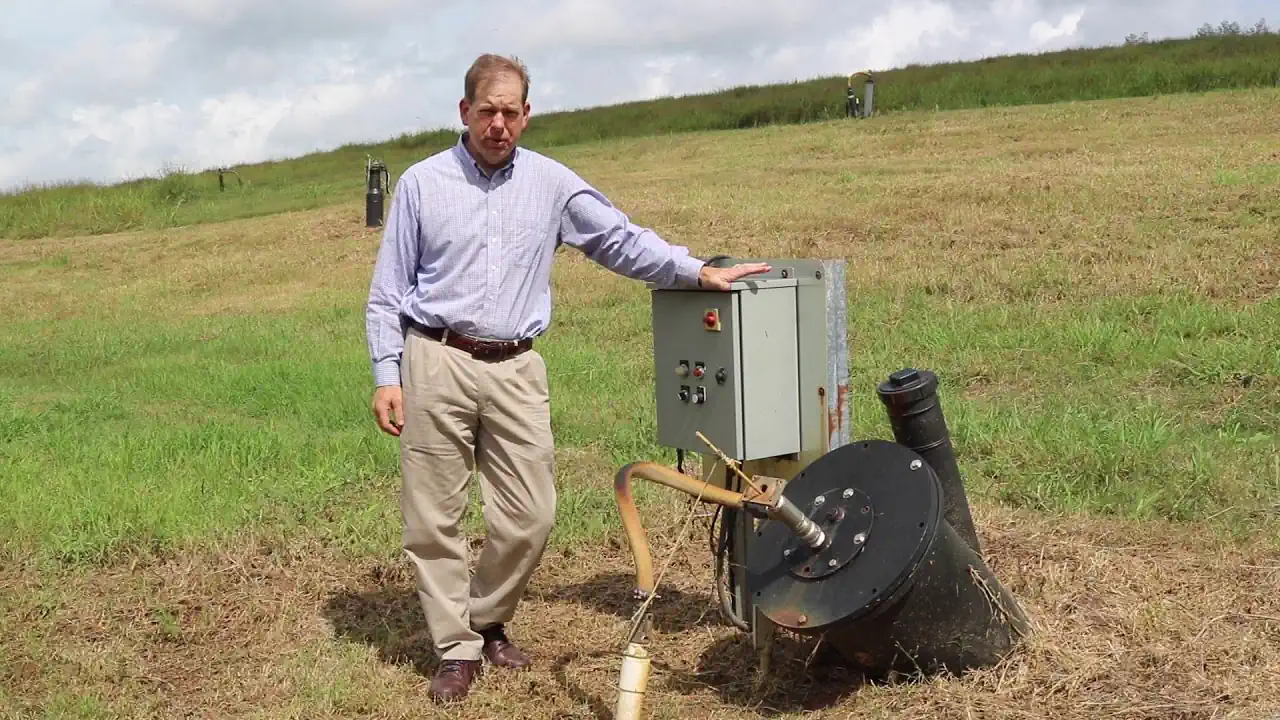
- Self-priming pumps are mounted at the top of the perimeter berm inside a protective structure, drawing leachate up through the riser pipe via lift from a pump at the base.
- Submersible systems require watertight, corrosion-resistant motor housings and specialised seals rated for continuous leachate immersion
- Both systems must never be accessed for unplanned or routine maintenance and inspection without applying site safety protocols for entering explosion risk (ATEX Regulation Regulated – EU) confined spaces
- Both system types require automatic float or level controls, check valves, and discharge piping — the difference lies in where those components are located and how accessible they are
Self-priming pumps are necessary as a means of controlling both construction and long-term maintenance costs. The accessibility advantage translates into faster service times, lower labor costs per maintenance event, and reduced safety exposure for field technicians. That said, rotating spindle self-priming systems have lift limitations — typically around 20 to 25 feet — that make them unsuitable for deep cells.
For very deep landfill cells where submersible pumps are required, the design must account for the full weight of the submerged pump and discharge line during extraction events. This often necessitates a mechanical retrieval system or davit arm installed at the riser pipe head — an additional capital cost that is easy to overlook in preliminary budgets but becomes immediately apparent when a pump needs to be pulled for the first time.
The true cost comparison between submersible and self-priming systems only becomes clear when maintenance frequency and labour cost are modeled over a minimum 20- to 30-year operational horizon.
Submersible Pump Pricing and Installation Requirements
Submersible leachate pumps designed for landfill applications are not commodity items. They must be constructed at the relevant explosion rating (ATEX Regs. as applied locally – EU) from materials compatible with leachate chemistry — which will include elevated concentrations of ammonia, heavy metals, volatile organic compounds, and biological material — and their motor seals must withstand continuous immersion without failure. Purpose-built landfill submersible pumps from established manufacturers typically range from $3,000 to $12,000 or more per unit depending on flow rate, head requirements, and material specifications. Installation costs include the pump, discharge line, float controls, cable management, and the mechanical retrieval hardware at the surface.
Maintenance access for submersible leachate pumps is the central operational challenge. The entire pump assembly — including the pump body, discharge line, and electrical cable — must be physically extracted from the riser pipe for inspection, service, or replacement.
Fixed riser pipes of the type used in wastewater applications are not appropriate due to landfill settlement causing buckling when flexible HDPE chamber risers are used.
In a deep cell, this means handling a heavy, leachate-soaked pipe string that can weigh hundreds of pounds. The safety protocols required for this operation — fall protection, landfill gas explosion (ATEX) ratings, confined space procedures, appropriate PPE, and often a two-person minimum crew — add substantial labour cost to every maintenance event.
Self-Priming Pump Costs and Long-Term Maintenance Savings
Self-priming pumps come in a much wider range of sizes and price points than submersible units, and their surface-mounted installation makes them significantly less expensive to service over time, but spindle-driven types require a rigid chamber and both types are limited in well depth application.
A properly specified self-priming pump for a landfill leachate application typically costs $1,500 to $6,000 for the pump unit itself, with additional costs for the housing structure, inlet piping, check valves, and controls. The critical sizing constraint is suction lift — the vertical distance the pump must draw leachate upward — which must be carefully evaluated against the pump’s NPSH (Net Positive Suction Head) requirements to ensure reliable operation across the full range of leachate levels in the sump.
Control Panel and Electrical Infrastructure Costs
Every leachate pump system requires automated level controls and a dedicated electrical or hydraulic supply. A basic pump control panel for a single leachate pump — including float switches or pressure transducers for level sensing, motor starter, alarm outputs, and SCADA connectivity — typically costs $3,000 to $10,000 depending on complexity and the degree of remote monitoring integration required. More sophisticated systems with telemetry, automated reporting, and redundant level sensing push that cost higher, but they also reduce the need for frequent manual site visits, which has real operational value at most landfill locations.
Electrical infrastructure costs depend entirely on the proximity of grid power to the pump location. Running a new service line to a perimeter berm location can range from a few thousand dollars for a short trench to $30,000 or more for a long run requiring conduit installation, transformer upgrades, and utility coordination. Solar-powered pump systems are increasingly used at remote leachate collection points as a cost-effective alternative to grid extension, though they may require appropriately sized battery storage to maintain reliable operation through low-solar periods.
Discharge Line Sizing and Material Costs
The discharge line carries extracted leachate from the pump to either an on-site storage tank, a leachate pretreatment system, or a connection point for tanker truck loading. Sizing the discharge line requires calculating flow velocity, friction losses, and any elevation changes along the route — undersized discharge lines create backpressure that reduces pump efficiency, accelerates wear and may lead to blockages. For most single-cell leachate pumping applications, 2-inch solid HDPE discharge pipe has become the standard specification, but the provision of a roddable or jettable pipe diameter of 4-inches discharge lines is repaid as soon as a smaller diameter pipe blocks and can only be repaired by full replacement.
Discharge line routing adds cost that is easy to underestimate on a site plan. The line must be protected from vehicular traffic where it crosses active areas of the landfill, which typically means either burial in a trench with appropriate cover depth or installation within a protective conduit. Burial costs for discharge lines run $15 to $40 per linear foot including trench excavation, bedding, pipe, and backfill — and in a large facility, the discharge line route from a remote disposal cell to the central leachate management area can exceed 1,000 feet.
Engineering and Design Fees for Leachate Collection Systems
Engineering fees for leachate collection system design are not a line item to minimise. The design process involves hydraulic modelling of leachate generation rates, pipe network sizing, gradient verification, pump selection, liner compatibility review, and coordination with the overall landfill cell design — all of which must be documented to a standard that satisfies state regulatory review. Cutting corners on engineering at this stage creates problems that are exponentially more expensive to fix after construction.
For a single lined disposal cell, engineering and design fees for the complete leachate collection and removal system typically range from $25,000 to $75,000 or more, depending on the complexity of the site, the regulatory requirements of the state, and whether the leachate system design is being developed as a standalone effort or as part of a broader cell construction permit package. Facilities in states with stringent composite liner requirements or those requiring peer review of design submittals will sit at the higher end of that range.
Regulatory Compliance and Permitting Costs by State
Permitting costs for leachate collection systems vary significantly by state and are driven by both the fee schedules of the regulatory agency and the complexity of the submittal required. Some states require highly detailed construction quality assurance plans, third-party CQA monitoring during liner and pipe installation, and post-construction certification reports — all of which carry professional service costs. State permit application fees for landfill cell construction range from a few thousand dollars in some jurisdictions to $50,000 or more in states with complex fee structures tied to disposal capacity.
Third-party CQA services — where an independent engineer monitors liner installation, pipe placement, and fusion joint quality during construction — add $20,000 to $60,000 or more to project cost per developed sub-cell, depending on the size of the cell and the duration of construction. These costs are non-negotiable in most states, and attempting to self-perform CQA functions is rarely accepted by regulators. Budget for CQA services as a fixed project cost, not a contingency item.
Hydraulic Modeling and Gradient Design Costs
Hydraulic modeling for leachate collection system design involves calculating the maximum leachate head that will develop above the liner — a parameter regulated under federal and state rules as the Maximum Design Head. EPA guidance under Subtitle D limits the maximum leachate depth above the primary liner to 30 centimeters (approximately 12 inches) in most MSW landfill applications. Verifying through hydraulic modeling that a proposed pipe network, spacing, and gradient will maintain leachate head below that threshold is a core engineering deliverable, and the modeling work — typically performed using established analytical methods or numerical models — adds to the engineering fee.
Gradient design is equally important and often underappreciated as a cost driver. The liner system must be graded to create a consistent slope toward the collection pipes and sump — typically a minimum of 2% slope on the liner surface. Achieving that grade requires careful subgrade preparation and survey verification, which adds both grading contractor cost and survey cost to the project. If the natural subgrade does not support the required geometry, structural fill may be required, adding further to earthwork cost.
Ongoing Maintenance Costs You Cannot Ignore
Capital costs get most of the attention in leachate system budgeting, but the maintenance cost picture over a facility’s operating life is where the real financial exposure lives. Leachate collection pipes accumulate biological growth, chemical precipitates, and fine sediment over time — a process that progressively reduces pipe capacity and, if left unmanaged, leads to leachate buildup above the liner that violates regulatory head limits.
The pumping system requires regular inspection, service, and eventual replacement of wear components. And discharge lines, controls, and electrical systems all have finite service lives that must be planned for in long-term financial assurance calculations.
Jet Cleaning Costs for Leachate Collection Pipes
Jet cleaning — using high-pressure water delivered through a specialized nozzle pulled through the pipe — is the primary maintenance method for keeping leachate collection pipes free of biological growth, chemical scale, and sediment accumulation.
Some specialist engineers recommend cleaning both the leachate collection pipes and the riser pipes during each cleaning event, and using a vacuum truck simultaneously to remove liquids that reach the lowest point in the pipes (washout chambers) during jetting. Skipping either step leaves residual material that accelerates re-clogging and defeats much of the benefit of the cleaning event.
- Jet cleaning mobilization costs typically run $1,500 to $3,500 per event depending on contractor location and equipment type
- Per-linear-foot cleaning rates generally range from $3 to $8 per foot for standard collection laterals
- Vacuum truck costs add $800 to $2,000 per day to the cleaning event budget
- Riser pipe cleaning adds time and cost beyond the lateral cleaning scope — budget separately for each riser location
- Facilities with high-strength leachate or significant biological activity may require cleaning every 1 to 2 years rather than the more typical 3 to 5 year interval
- Liquids generated usually incur costs for their disposal
The consequences of deferred pipe cleaning compound quickly. As biological slime and chemical precipitates accumulate on pipe walls, effective pipe diameter decreases, hydraulic capacity drops, and leachate head above the liner rises. Once head exceeds regulatory limits, the facility is in violation — and emergency cleaning under regulatory scrutiny may easily cost far more than a routine scheduled cleaning event. Building jet cleaning into the annual operating budget from day one is not optional maintenance; it is regulatory risk management.
Access for jet cleaning equipment is a design consideration that is often overlooked until the first cleaning event reveals a problem. The jetting nozzle and hose must be introduced into the collection pipe network through cleanout access points — typically located at the riser pipe or at dedicated cleanout risers installed at the ends of lateral runs. Facilities that were designed without adequate cleanout access often require expensive retrofit work to create entry points for cleaning equipment. Design engineers should confirm that cleanout spacing meets practical jetting equipment limitations, which generally means access points every 300 to 500 feet of pipe run.
Pump Extraction, Inspection, and Replacement Costs
Whether a facility uses submersible or self-priming pumps, routine pump inspection and service is a recurring cost that must be planned for. Submersible pump extraction events — where the full pump and discharge line assembly is pulled from the riser pipe — typically require a two-person crew, mechanical lifting equipment, and a full day of labor per pump location.
At current contractor labor rates, a single submersible pump extraction, inspection, and reinstallation event can cost $2,000 to $6,000 depending on riser depth and site conditions.
Pump replacement, when wear or failure makes repair uneconomical, adds the cost of the replacement unit — typically $3,000 to $12,000 for a purpose-built landfill submersible pump. Self-priming pump inspection and service is substantially less expensive because the pump is surface-mounted and accessible without confined space procedures, with typical annual service costs running $500 to $2,000 per pump location for routine maintenance events.
Video Inspection Costs After Cleaning Events
Post-cleaning video inspection of leachate collection pipes is a best practice that is increasingly required by state regulators as part of facility compliance programs.
A CCTV inspection crawler pulled through the pipe network after each jet cleaning event provides documented evidence of pipe condition, confirms that cleaning was effective, and identifies any structural issues — joint separations, pipe deformation, or liner intrusions — that require remediation. Video inspection costs typically run $2 to $5 per linear foot for standard crawler inspection, plus mobilization costs of $1,000 to $2,500 per event.
While this adds to the total maintenance budget, the documentation value is significant: video records of pipe condition provide defensible evidence of system performance during regulatory audits and can identify developing problems before they become compliance emergencies.
Leachate Treatment and Disposal Adds to Total System Cost
Collecting leachate is only half of the cost equation — what happens to it after collection is a major ongoing operational expense that must be integrated into the total system cost picture from the planning stage. Leachate is a regulated industrial wastewater, and its treatment or disposal requires either on-site treatment infrastructure, off-site disposal arrangements, or some combination of both. None of those options are inexpensive, and leachate volumes at active landfills can be substantial, particularly in high-precipitation regions.
The interplay between leachate generation rate and treatment or disposal cost creates a long-term financial exposure that should be modeled explicitly in any facility’s financial assurance calculations. Regulators require landfill operators to demonstrate financial assurance for post-closure care costs, and leachate management is a significant component of those costs. Underestimating long-term leachate treatment and disposal expenses in financial assurance models is a common error — and one that can create serious regulatory and financial problems decades after a cell closes.
Leachate Treatment and disposal costs are considered in more detail in our leachate treatment pricing article.
How to Get the Most Accurate Cost Estimate for Your System
The only way to get a cost estimate you can actually build a budget around is to engage a qualified environmental or geotechnical engineer to perform site-specific hydraulic modelling, develop a detailed design basis, and solicit competitive bids from qualified HDPE pipe contractors and pump suppliers with landfill experience.
Ballpark figures from general construction cost databases are a starting point for feasibility analysis, but they routinely miss site-specific cost drivers — liner compatibility requirements, riser depth, discharge line routing, state-specific CQA obligations, and local contractor market conditions — that can move the total project cost by 30% to 50% or more. The investment in proper front-end engineering always returns more than it costs in avoided change orders, redesign, and regulatory delays.

Frequently Asked Questions
The questions below address the most common cost-related issues waste management professionals encounter when planning, designing, or operating leachate collection systems. The answers reflect real-world conditions across a range of facility types and regulatory environments.
Quick Reference: Leachate Collection System Cost Summary
HDPE Pipe (material only): $2 – $50+ per linear foot depending on diameter and SDR
Sump Construction: $15,000 – $60,000+ per sump
Submersible Pump (unit cost): $3,000 – $12,000+
Self-Priming Pump (unit cost): $1,500 – $6,000
Control Panel and Electrical: $3,000 – $10,000+ per pump station
Engineering and Design: $25,000 – $75,000+ per cell
CQA Services: $20,000 – $60,000+ per construction event
Jet Cleaning (per event): $3,000 – $15,000+ depending on pipe length
Video Inspection: $2 – $5 per linear foot plus mobilization
Leachate Hauling: $0.05 – $0.15 per gallon
These figures provide a working reference for preliminary budgeting, but every number in this table is subject to significant variation based on site conditions, state regulatory requirements, and current contractor and material pricing. Use them to frame conversations with engineers and contractors — not as final budget commitments. For more insights, explore strategies for minimizing leachate generation in landfills.
One cost category that surprises many operators is the cumulative weight of ongoing maintenance costs over the facility’s post-closure care period — which can extend 30 years or more after the last waste is placed. Leachate collection systems must remain operational and compliant throughout that entire period, meaning pump replacements, pipe cleaning events, and video inspections continue long after the revenue-generating phase of facility operations has ended. Factoring those long-term maintenance costs into post-closure financial assurance calculations from the design stage is a critical planning discipline that is too often left to the end of the permitting process.
Regulatory requirements also shift over time, and leachate collection systems installed 20 years ago may face retrofit requirements as state standards evolve. Designing systems with flexibility for future modification — accessible cleanout points, oversized riser pipes that can accommodate upgraded pump equipment, and electrical infrastructure with spare capacity — is a form of cost management that pays dividends over the life of the facility even if it adds modestly to initial construction cost. For more information on effective strategies, explore strategies for minimizing leachate generation in landfills.
How much does HDPE pipe cost per linear foot for leachate collection systems?
HDPE pipe for leachate collection systems ranges from approximately $2 to $4 per linear foot for 2-inch solid discharge pipe up to $28 to $50 or more per linear foot for 12-inch solid HDPE trunk lines with low SDR ratings required for deep cell applications. Perforated collection laterals in the 4-inch to 6-inch range — the most commonly used sizes for collection laterals — typically run $5 to $20 per linear foot for material alone, depending on diameter, SDR rating, and whether geotextile sock wrapping is specified. Installation labor, fusion joining, fittings, and liner protection measures all add to the total installed cost per linear foot. For more insights on cost factors, you can explore leachate treatment plant pricing and its impact on overall system expenses.
What is the difference in cost between submersible and self-priming leachate pumps?
Submersible leachate pumps purpose-built for landfill applications typically cost $3,000 to $12,000 per unit, while self-priming surface-mounted pumps run $1,500 to $6,000 per unit — giving self-priming systems a meaningful upfront cost advantage. The more significant difference emerges over time in maintenance costs: submersible pump extraction events cost $2,000 to $6,000 each in labour and equipment, while self-priming pump service events run $500 to $2,000 due to surface accessibility. For deep cells where submersible pumps are required by hydraulic constraints, operators should model the full 20-year maintenance cost differential before assuming submersible systems are the only viable option — intermediate pumping stages or alternative riser configurations sometimes make self-priming systems viable even in deeper applications.
How often do leachate collection pipes need to be jet cleaned and what does it cost?
Jet cleaning frequency depends on leachate chemistry, biological activity in the waste mass, and the specific pipe materials and gradient of the collection system — but a typical range for most MSW landfill applications is every 1 to 5 years per cleaning event. Facilities with high-ammonia or high-organic-strength leachate, or those in warm climates where biological activity in the pipe is elevated, generally require more frequent cleaning. A single jet cleaning event including mobilization, jetting of collection laterals and riser pipes, and vacuum truck service for liquid removal typically costs $3,000 to $15,000 or more depending on the total pipe length cleaned, contractor rates, and site access conditions.
Does landfill depth significantly affect the total cost of a leachate collection system?
Yes — landfill depth is one of the most direct cost multipliers in leachate collection system design, affecting pipe specifications, pump selection, riser pipe cost, discharge line length, and long-term maintenance logistics simultaneously. Deeper cells require lower SDR (thicker wall) HDPE pipe to withstand the higher compressive loads from overlying waste, which increases material cost per linear foot across the entire collection network. Riser pipe cost scales linearly with depth, and deeper risers mean longer discharge lines, higher friction head losses, and more demanding pump specifications — all of which push equipment costs upward.
The maintenance cost implications of depth are equally significant. Submersible pump extraction from a deep riser requires mechanical lifting equipment and extended crew time, with costs per event running substantially higher than extraction from a shallow cell. The physical handling of long, heavy, leachate-soaked discharge pipe strings from deep cells also creates meaningful occupational safety exposure that must be managed through proper procedures, equipment, and training — all of which have associated costs.
When comparing design alternatives for a new disposal cell, the cost implications of cell depth versus footprint should be explicitly analyzed. A deeper cell with a smaller footprint uses less land area, which may be advantageous from a permitting standpoint, but the incremental cost of deeper leachate collection infrastructure — in both capital and long-term maintenance — must be weighed against those benefits as part of the site development economics analysis.
What engineering and permitting costs should I budget for when designing a leachate collection system?
Engineering fees for a leachate collection system design embedded within a single lined disposal cell construction permit package typically range from $25,000 to $75,000, with more complex sites or states with detailed submittal requirements pushing above that range. This includes hydraulic modeling, pipe network sizing, gradient verification, pump selection documentation, liner compatibility review, and preparation of construction drawings and specifications to the standard required for regulatory submittal. Stand-alone leachate system engineering — separate from the overall cell design — may carry different fee structures depending on the scope of work.
State permit application fees vary widely — from a few thousand dollars in straightforward jurisdictions to $50,000 or more in states with fee schedules tied to permitted disposal capacity or cell acreage. Third-party CQA monitoring during construction adds $20,000 to $60,000 or more to the project budget and is non-negotiable in most states. Post-construction certification reporting, which documents that the system was built in conformance with the approved design, adds further professional service cost that should be included in the project budget from the outset.
One frequently overlooked cost category in the permitting phase is response to regulatory comments. Most state agencies issue comment letters on permit submittals that require engineering responses, revised drawings, or supplemental calculations — a process that can add $5,000 to $25,000 in additional engineering fees beyond the original submittal scope. Building a contingency for regulatory response costs into the engineering budget, rather than treating comment response as out-of-scope, produces a more realistic total cost picture and avoids budget friction during the permitting process.
For waste management professionals navigating the complexity of leachate system design, permitting, and long-term compliance, Geodsyn Tech offers specialised environmental engineering services that support facilities from initial design through post-closure care.
When managing waste disposal, understanding the costs associated with a leachate collection system is crucial. From the selection of HDPE pipes to the choice of pumps, each component plays a vital role in the overall budget. It’s essential to consider the design costs as well, as they can significantly impact the efficiency and effectiveness of the system.
Further Reading
For more information about leachate collection and extraction read our this.
For more detailed information on what leachate is and its implications, you can visit this comprehensive guide on leachate. (Link coming soon!)