
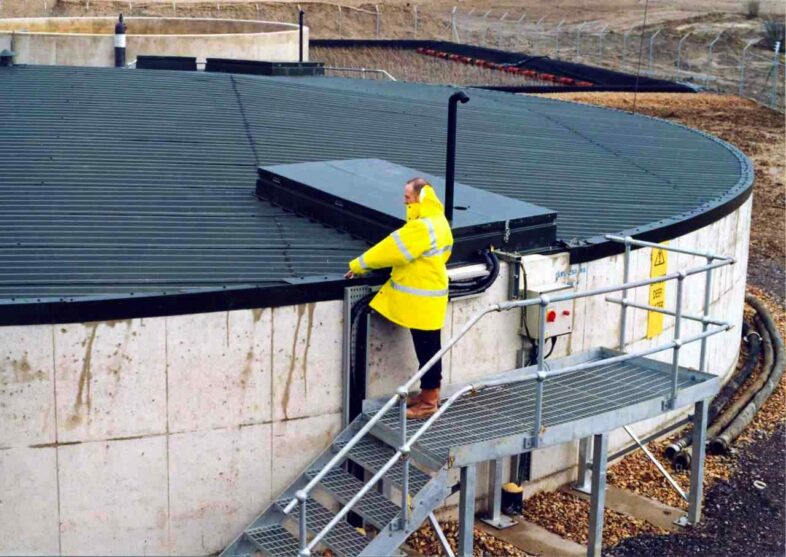

A very wide range of treatment processes have been applied to leachate treatment with varying success. The processes which have been consistently successfully applied, for municipal waste landfill leachate from controlled landfills, are biological processes designed by specialist leachate process designers.
Biological nitrification treatment
In the UK leachate treatment has over the last 30 or more years, mostly required just biological nitrification treatment, in sequencing batch reactor-type leachate treatment plants.
In many countries, standard national discharge consents limit the applicability of biological processes in order to reduce the complexity of process selection.
Watercourse consent simplification leads to higher costs for local industry
In our view this is not a conscious decision made in favour of more expensive options, it is simply a result of consents which are designed for simplicity as national standards, and which adopt a requirement that all discharges must meet a high-quality standard suitable for all cases.
 While this no doubt leads to simplified discharge consenting and reduces the workload of government environmental regulators, the cost to local industries will be unnecessarily high where watercourses could be providing substantial dilution which would, by site-specific impact risk analysis, under a different licensing regime, enable justification of a more relaxed consent to the UK model.
For example, many national consents limit COD, and Salinity, both in arid areas and where little or no irrigation will be undertaken.
More advanced treatment technologies including denitrification are now needed to reduce pollutants from landfills
Biological processes for the treatment of old landfill leachates are only partially effective in removing COD, and not at all effective in Salinity reduction, but in reality, this is seldom likely to present a risk of impact on the receiving watercourse, (unless low flows are very low and provide little dilution).
As a result of “broad brush “National Standard” consents for leachate treatment plants overseas from the UK, on many occasions raise costs by requiring a further process stage (after initial nitrification treatment) which is known as “denitrification”.
Other more highly (non-biological) technological processes have been used, in many countries. These include the use of the Reverse Osmosis process – sometimes as the sole treatment stage, but more often in combination with biological treatment.
It should be recognised from the start that such processes are inherently more expensive to run than biological processes (such as the SBR-activated sludge extended aeration process), and depending on the destination of the concentrate produced may be very much less sustainable than biological treatment.
RO Plant Leachate Treatment May Not be A Permanent Solution
For example, if the concentrate is returned to the landfill from an RO Plant, over many years the leachate emanating will actually become stronger, not weaker.
In contrast, biological treatment is “treatment” in its fullest sense. It converts the contaminants into other chemicals with a far lower contaminating potential and will remove those contaminants from the waste.
“Leachate treatment by biological nitrification is the most common and most successful”
There are more than 70 nitrification-type biological treatment plants in use across the UK, and there are more in many other countries.
SBR with Nitrification Followed by Denitrification Is Usually the Best Available Technique (BAT)
At IPPTS Associates we firmly believe that biological leachate treatment in an SBR remains the Best Available Technique (BAT) for many municipal landfill leachates.
The UK Environment Agency will continue for the foreseeable future to apply a policy which, while ensuring compliance with minimum set Environmental Quality Standards for each watercourse into which treated leachate will pass, allows consideration of each discharge on the basis of a site-specific impact risk assessment.
How about biological treatment when the discharge is to the sea and has to meet UWWTD standards but not nitrify. What %COD removal can be obtained?
Presumably by meeting Urban Wastewater Treatment Directive standards you are seeking a 75% or better removal of COD by the plant as would be required of a Water Utility Company operating a Wastewater Treatment Works. A well implemented and operated aerobic biological nitrification process will reliably achieve a COD removal rate which is related to the ammoniacal nitrogen in the leachate initially, and thus varies for different strength and age of leachates.
However, for modern EU Landfill Directive compliant landfills we would achieve certainly over 50% COD removal just from the settled single stage effluent, and commomly up to 65% COD removal with simple in reactor settlement only.
To go better than that in most cases up to 75% removal without denitrification is achievable with any one of many tertiary treatment methods, without the cost and complexity of dentrification, but in these plants you will of course nitrify (i.e. produce nitrate (NO3) from the ammoniacal nitrogen (NH4-N)).
That nitrate can be, of course, be a problem for fisheries especially in estuaries where there is little dilution available, and concerns exist about the risk of estuarial eutrophication.
The options after biological treatment of this sort are then:
a) Adding a further biological denitrication stage, or possibly
b) Reverse Osmosis (RO), with or without, Ultra-filtration.
Care is needed before adopting RO as the method of disposal of the concentrate may well not be sustainable, if the intention is to return it to the landfill. If the residue is not disposed back into the landfill, the cost of disposal of the concentrate as a hazardous waste can often be prohibitive depeding on reasonably local availability of haz waste disposal facilities, and in that case denitrification is the best option.
If you would like to email me direct, or use our Contact Form I would be pleased to send you copies of peer reviewed technical papers presented at conferences showing results achieved in such biological leachate treatment plants.
There is a new treatment process that uses RBC technology (standard for biological treatment), but is a chemical process, based on Fenton’s principal. It has achieved much better results than biological treatment and can be used in conjunction with biological treatment. Full Disclosure: It is a startup venture that I am involved in, EcoH2O LTD.
Has it been demonstrated for treating leachate from a modern landfill? RBCs were used for leachate treatment in the 1980s and 1990s in the UK, but experienced problems and their proponents have ceased promoting such designs for leachate, as far as I am aware.
I believe one major problem was their susceptability to cooling of the exposed biomass on the rotors. You have to appreciate that just an hours heating failure, perhaps even less, can damage the viability of the exposed biomass on the surface of the rotors.
If the biomass falls off the rotor surface the ability for an RBC to treat effectively will be impaired for a long period, especially in the winter, when the treatment capacity is probably needed most due to seasonally high UK rainfall.
Those are just my thoughts. Sorry, not to be more positive, unless of course you have solved that one as well?
What are the perimeters to be tested in leachate water? Is selenium harmful if it is slightly more than the required level?
Actually what standard must be achieved when discharging the teated leachate into the waterway like rivers?
Your reply please. Thanks.